Archives: Projects
-
Earned Cuddlist Certificate
Completed the Cuddlist Training, received feedback from two cuddle clients, had an approval session with an approved evaluator, had a background check, and had a finalization call with Madelon Guinazzo, co-founder of Cuddlist. This certified me as a Cuddlist Certified Professional Cuddler.
-
Completed Cuddlist Training
I completed a professional cuddler training program and earned my Cuddlist Trained certificate. I highly recommend the training. It’s all about boundaries, consent, and creating a safe space for therapeutic touch. If you are interested in becoming a professional cuddler, you can save 10% on the training by using my discount code DANIELG (must enter in ALL CAPS).
-
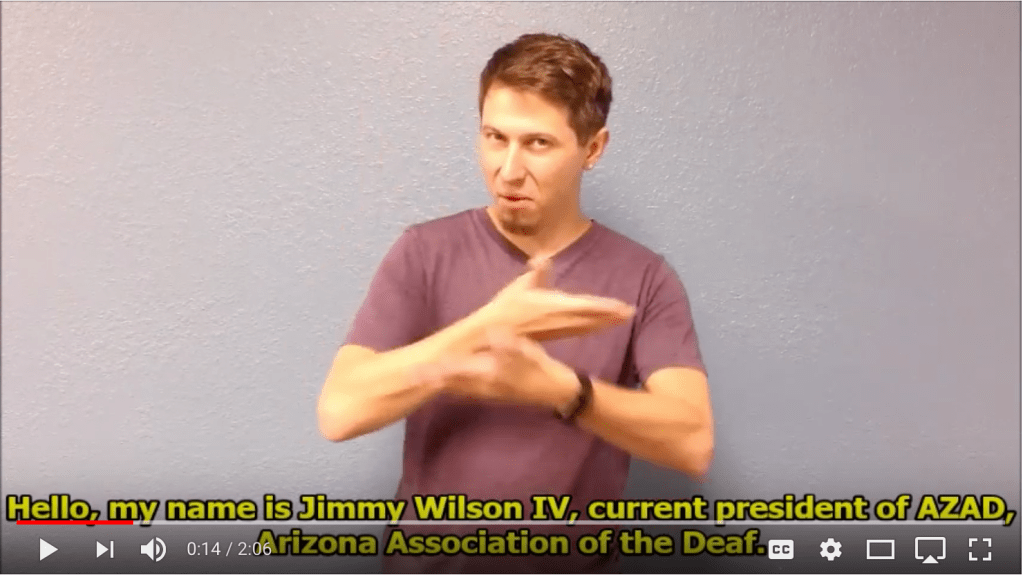
Voiceover for ASL video September 2018
I was hired to record a voice narration of this video that was originally recorded in American Sign Language. I was given an English translation and, after watching the video, I made a few minor adjustments to the English with the producer’s permission. The main challenge was to figure out exactly where I needed to speak faster or slower to keep up with the signing. This was a good experience in translation and voiceover work!
Thank you, Arizona Commission for the Deaf and Hard of Hearing (ACDHH) and Arizona Freelance Interpreting Services (AZFLIS) for this opportunity. Thank you, also, Jimmy Wilson IV. I hope I did you justice.
-

Plans to instill reflective practice throughout an ASL course
This summer, I took a course required of all instructors who teach in the Maricopa Community College District: EDU250 – Teaching and Learning in the Community Colleges. It was actually a very good course on classroom teaching in general – a refresher and expansion on what I learned about education in the Master of Arts in Interpreting Studies with an emphasis in Teaching Interpreting program I took at Western Oregon University. I took EDU250 at the same time as Conversations with Stakeholders: Practicum and Mentorship through the National Consortium of Interpreter Education Centers (NCIEC), and the last section of this course was about reflective practice. The assignment to write “thoughts, goals, ideas, and objectives … of something we want to complete” made me think of writing this plan.
Plan to instill reflective practice in an ASL course
Course: SLG101 – American Sign Language I
Textbook: Signing Naturally Units 1–6 workbook with DVDMethodology
Signing Naturally has self-assessment built into it; it is just a matter of how the teacher takes advantage of this feature. I plan to use it to collect data electronically in a way that I can evaluate and share with students. Each unit in Signing Naturally has a self-assessment at the end which asks students to rate the comfort and confidence they feel, on a scale from 1 to 5, in the skills they learned in that unit.
I will assign the students to complete this self-assessment from their workbook in a Google Form survey. I create the survey using the same questions in the workbook, and for each question, I have the students select a number from 1 to 5 on a scale. For example, here a screenshot of the form header and first question:
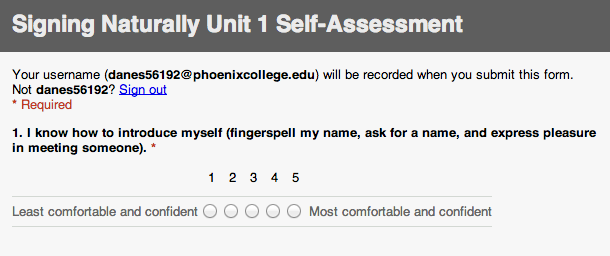
Screenshot of Google Form header and first question The Signing Naturally workbook also has a “Questions to Ask” that the students are instructed to practice asking in ASL. These questions give them practice in the expressive (not receptive), skill areas addressed in the unit self-assessment. The same questions are modeled in the Unit Review section of the DVD. I have the students study the questions, watch the signer model them on the DVD, practice signing the questions themselves, and video record themselves signing the questions. I then have them post the video to YouTube, marking it Unlisted so others on the Internet cannot view them, and send me the link. I recommend that they watch themselves signing the questions as a reflective practice and to help them in completing their unit self-assessments. I watch the videos to assess their competence and give them feedback by text and/or video response.
Another way I will create opportunities to compare the students’ self-assessment with my assessment of their performance is to write my receptive exams with those skill areas in mind. For example, for the self-assessment question “I can follow classroom instructions,” I can ask the students to write the correct response to the direction YOU NAME WRITE-DOWN and see if they write their name in the space provided.
I do not have the technology for the students to enter their exam answers electronically, so I will enter the data of each student’s performance in a spreadsheet. In the left column, I will list student’s ID, and in subsequent columns, I will put the skill areas in a header that matches the header in the spreadsheet made from their self-assessment. For example, I would have “Skill 4” as the header of the second column of the spreadsheet, and I would put the student’s score on the exam question I designed to assess that skill. Since the students self-assessed their comfort and confidence with skill area 4, “I can follow classroom instructions,” and I tested their performance in this skill area by asking them to write down their name, I will enter a 1 or a 0 depending on whether they performed satisfactorily in this skill area.
Benefits
There are several benefits to having the student enter their data electronically:
- I get to collect all the answers from all the students, and:
- I don’t have to take the time to look at each student’s book, which I will probably forget after looking.
- I don’t have to collect papers, which is ecologically friendlier, lighter and less space-consuming, and students don’t have to remember to bring papers with them to class.
- I don’t have to enter their data myself.
- I get data I can actually use in various ways, such as:
- Assessing how each student is doing
- Assessing how the class as a whole is doing
- Assessing how one class is doing compare to another class in the current semester or future semesters
- I can adjust my teaching to ensure the students learn the course competencies and unit objectives
- I can share the aggregate data with the students by projecting a chart on the screen in the classroom so they see how they did as a class, and see why we are focusing extra attention on the weaker areas the day of the unit exam review.
There is another advantage to self-assessment: the students can compare the assessment in the unit exams to their own self-assessment, and get a sense of the accuracy of their self-assessment skills.
The Signing Naturally workbook does not contain unit exams; however, I will design my unit exams with the course objectives in mind. For example, for the self-assessment question “I know how to introduce myself (fingerspell my name, ask for a name, and express pleasure in meeting someone)” there is a corresponding “question to ask” in the workbook “ask the person’s name.” I may expand the assignment to have the student fingerspell their own name, ask a person’s name, and express pleasure in meeting them. That, then gives both the student and me an opportunity to compare the student’s self-assessment with their actual performance on the expressive part of the unit exam (the Questions to Ask video they submit on YouTube). My goal in this, and I will explain this to the students, is for them to become reflective practitioners, get to know themselves as learners, improve their learning based on their self-assessment.
Limitations
Granted, there are limitations to comparing self-assessment to performance, including:
- The student may not understand the self-assessment questions, and hence not accurately assess themselves on the correct skill areas (e.g., the student might not remember what fist letters are in the question “I know the correct handshapes for fist letters”).
- The students may, and I hope will, improve upon their skill in the areas they self-assess by getting help on those areas in class on review day, and studying harder on those areas, both by themselves and in study groups.
- The students may feel inferior to other students when the see how they did compared to how other students did.
- The students might resent the teacher for pointing out the inaccuracy of the student’s self-assessment.
- The students might, ultimately, not know what to make of the data they are given about their own self-assessment in comparison to the teacher’s assessment of their performance on exams.
- The students might not learn how to self-assess or use self-assessment and external assessment to improve their learning.
- The instructor might not design exam questions that accurately measure student achievement in each skill area.
- The instructor might make errors in grading the paper exams.
- The instructor might make data entry errors in transferring the scores on the paper exams into an electronic spreadsheet.
- There might be technical difficulties comparing the self-assessment spreadsheet with the exam results spreadsheet.
- The instructor might not learn from these assessments and might not improve his teaching.
Safeguards
- I will give the students opportunities to self-assess in class by using another technology, a student response system (SRS) such as Poll Everywhere, so they can get practice in self-assessment and can feel a lack of pressure since they are sending their ratings anonymously.
- I will display the aggregate answers on a screen so students can see how their classmates self-assessed. This can sometimes alleviate students’ feelings of being alone in feeling insecure on a point.
- I will not be heavy-handed or use evaluative language when informing students of their self-assessments, my assessments, and the differences between the two. I will non-judgmentally present the data for their consideration.
- I will compassionately guide the studentsinevaluatingtheirself-assessmentin relation to their exam results and engage them in a dialogue about how they feel about any discrepancies. I can ask them:
- Did they feel the test questions were fair?
- Did they understand what they were rating themselves on in the first place, or were they confused about the self-assessment questions?
- Did they improve upon their self-assessment through studying alone, in class during the review, and in study groups?
- What study techniques were most effective in improving their exam performance vis-à-vis their pre- exam review self-assessment?
- I will use the data collected to refine my questions on subsequent exams and continually improve the validity of my exams.
- I will maintain all records using best practices in accordance with the Family Educational Rights and Privacy Act (FERPA).
I look forward to doing this action research in objectives-based evaluation, use of instructional technology, and methods of assessment to improve my teaching and my students’ learning.
References
Maricopa Community College District. (n.d.). EDU250 – Teaching and learning in the community college – Official course description. Retrieved from http://www.maricopa.edu/curriculum/D-L/076edu250.html
Mikos, K., Smith, C., Lentz, E. M. (2008). Signing naturally: Student workbook 1–6. San Diego, CA: Dawn Sign Press.
- I get to collect all the answers from all the students, and:
-
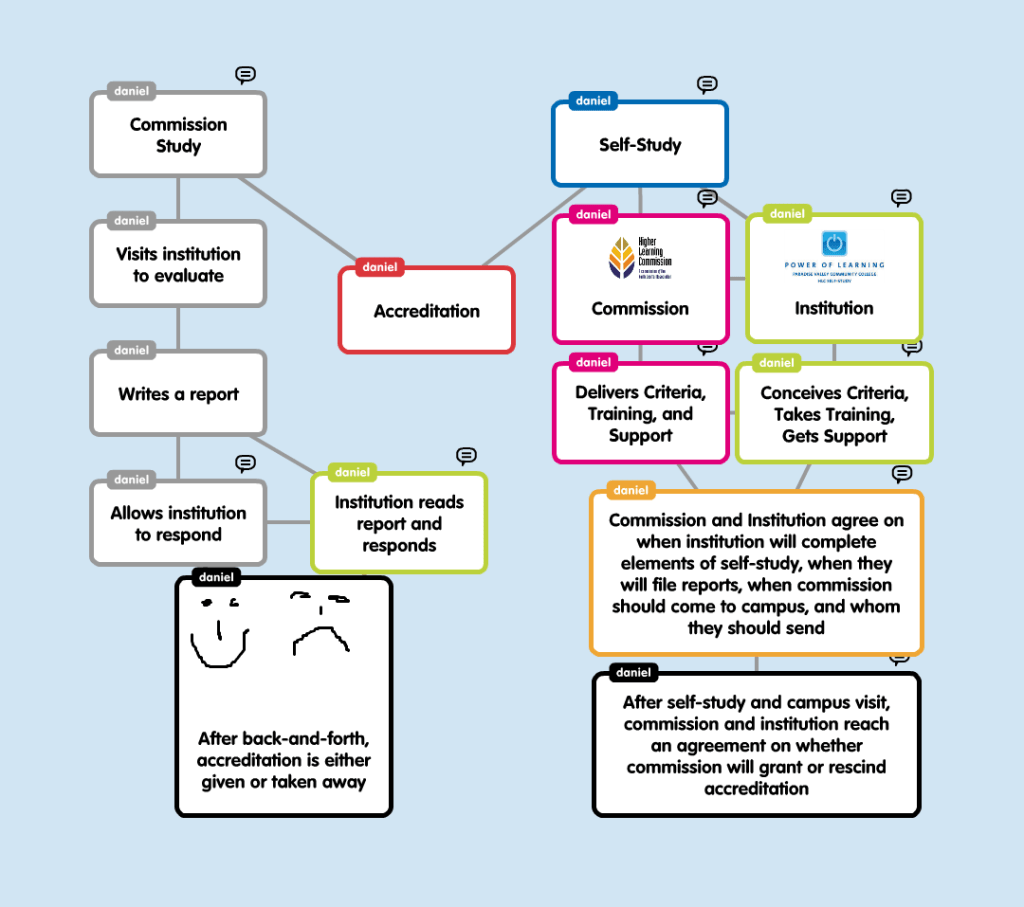
Concept Map using Popplet
I completed this project for EDU250, Teaching and Learning in the Community Colleges, in July 2014. The assignment was:
Create your first Popplet. Title the Popplet About Accreditation and populate it with the information you gleaned through the readings and research exploration that you conducted this week regarding accreditation and the Higher Learning Commission.
-
Assessing Student Learning
Assignment Prompt
This project was completed for EDU250, Teaching in the Community Colleges. The assignment for this project was:
This week you reviewed chapters 28-31, exploring techniques for assessing our students knowledge of the learning outcomes.
You read that there are a number of strategies that we can use to assess student learning including test construction and grading, student preparedness for tests, and formative assessment techniques. In the eTech challenge you learned about student polling which you also learned about in chapters 27 and 28.
Please review this website created by Laura Ballard formerly of GateWay Community College, and now at Mesa Community College. The site provides a number of ways that student learning can be assessed using technology. Please note that technology should only be used if it adds value, not for digital bling.
So for this project, you will continue to work with the 1-3 learning objectives for the class that you identified in the the prior projects.
Using the techniques and information that you learned in the readings, create a summative assessment and a formative assessment that you can use to assess student learning of each outcome. Include a grading rubric for the summative assessment.
For each learning objective, you should submit:
- The learning objectives to be covered
- An assessment for each objective (this could be a project assignment, a test, etc.)
- A description of a formative assessment and what you would like to glean from the information obtained
- A description of why you chose the assessment technique and how they relate to your learning outcomes/objectives.
Learning Objectives
- Know what questions Deaf people are likely to ask you when you first meet them, and know how to respond appropriately
- Ask and respond affirmatively or negatively to yes/no questions
- Engage in a first-meeting conversation
1. Know what questions Deaf people are likely to ask you when you first meet them, and know how to respond appropriately
- Formative Assessment
- Lead the class in a conversation about what people ask each other when they first meet. This gets them talking about what they know, so they can connect the new with the known. Then get them to talk about the questions Deaf people ask ASL students, and why. I hope to glean whether they are aware of the discourse routines in their everyday conversations and if they know the difference between conversations they have had when meeting hearing people for the first time and the conversations they will have when they meet Deaf people for the first time. Make mental notes, notes on a tablet only I can see, and/or notes on the board capturing common insights and misperceptions. Clarify any confusion the students may have, and dispel any misconceptions they seem to have.
- Summative Assessment
- Have the students write a one-minute paper listing the questions a Deaf person will probably ask them when they first meet. Have the students turn in these papers, and give them a few points for a good faith effort. The only “rubric” would be that they responded to the prompt by listing relevant questions, at least half of which are correct.
- Rationale and Relevance
- I chose this formative assessment because the nature of the class, an ASL class, is immediate and interactive; conversation needs to be continuous, and very little time can be taken up with pauses for notating assessment. I chose this summative assessment because it allows them to memorize their knowledge by committing it to writing, and it shows me what they know. Both of these assessment relate to the learning objective because they directly assess the students’ knowledge.
2. Ask and respond affirmatively or negatively to yes/no questions
- Formative Assessment
- Demonstrate to the students how to nod your head when answering yes and shake your head when answering no to a yes/no question. Show them the ASL equivalent of “No, I am hearing” and “Yes, I am a student.” Have them pair up and practice asking and answering “Are you Deaf?” “No, I am hearing.” “Are you a student”? “Yes, I am a student.” Walk around the classroom and watch students practice the conversation in pairs. Correct some errors and make mental notes of common errors; also note patterns in individual students’ progress. After a few minutes, give feedback to the class on what most of them showed they comprehended and didn’t comprehend.
- Summative Assessment
- The summative assessment for this learning objective will be subsumed in the summative assessment for “engage in a first-meeting conversation”
- Rationale and Relevance
- Responding to yes/no questions lives within the broader scope of a conversation, and the applicable conversation at this stage in the class (beginning of the term) is a first-meeting conversation. Therefore, it will be assessed within the next summative assessment.
3. Engage in a first-meeting conversation
- Formative Assessment
- Walk around the classroom and watch students practice the conversation in pairs. Correct some errors and make mental notes of common errors; also note patterns in individual students’ progress.
- Summative Assessment
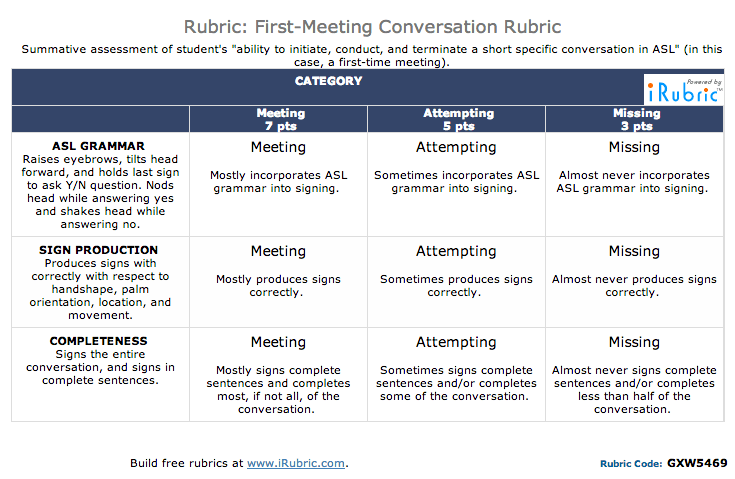
- Have pairs of students perform the conversation in front of the class, and give them a grade on the accuracy and naturalness of their performance. Make this assessment count as a quiz, a small percentage of their overall grade. See rubric below.
- Rationale and Relevance
- I chose this formative assessment because it gives students a chance to develop confidence in working toward the learning objective, and it shows me how far they are coming along in their progress; I chose this summative assessment because it encompasses the first two learning objectives. In order to have a first-meeting conversation with a Deaf person, the students need to understand the questions Deaf people will ask them, and know how to respond appropriately. The first part of this conversational skill is knowledge. The next part, as a foundation to the rest, is to know how to grammatically ask and answer a yes/no question; the last part is combining all three to “apply the ability to initiate, conduct, and terminate a short specific conversation in ASL” (official course competency XII).
-
Rubric for Summative Assessment
First-Meeting Conversation Rubric
Resources
MCCCD Program Description, American Sign Language I. Center for Curriculum & Transfer Articulation, Division of Academic and Student Affairs. Retrieved from https://aztransmac2.asu.edu/cgi-bin/WebObjects/acres.woa/wa/freeForm2?id=56062
Nilson, L. B. (2010). Teaching at its best: A research-based resource for college instructors. Wiley. Kindle Edition.
-
Lesson plan incorporating visuals & technologies to address various learning styles
Assignment Prompt
This project was completed for EDU250, Teaching in the Community Colleges. The assignment for this project was:
This week you reviewed chapters 23, 25-27, exploring ways to make learning easier for your students.
You read that there are a number of strategies that we can use to get our students to do the readings, and ways to personalize learning in regard to learning style. You also learned some tips for using visuals in your classes and were exposed to some low and high tech strategies for incorporating technology in your classes, which should relate to some of the eTech challenges we have been working on.
So for this project, you will continue to work with the 1-3 learning objectives for the class that you identified in the the prior projects.
Using the techniques and information that you learned in the readings, identify the teaching and learning techniques that you would use to engage your students with the content including reading, addressing learning styles, using visuals and technologies.
Submit a plan for those objectives including:
- The learning objectives to be covered
- Techniques for students to do the reading
- Addressing different learning styles
- Using visuals
- Using technologies
- A description of why you chose the technique and how they relate to your learning outcomes/objectives
Learning Objectives
- Engage in a first-meeting conversation
- Ask and respond affirmatively or negatively to yes/no questions
- Know what questions Deaf people are likely to ask you when you first meet them, and know how to respond appropriately
Techniques for Students to Do the Reading
At the beginning of the course, I will show students how to read the workbook, watch the DVD, and write/draw in the workbook to complete the exercises. I will give them hints on how to read the text; for example, to read the first and last pages before reading those in the middle, scan for headings, words that are bold or italicized, look at the exercises in the book before watching the DVD so they know what to watch for; I will teach the students to watch the DVD once through; then watch it and answer questions in the workbook as they go; then check their answers with those in the back of the book (if there are any); then note what they got wrong and what the correct answer is; then watch the DVD again to see if they can see the correct information being signed. I will show them how to pause the DVD as necessary, but review the DVD for longer and longer periods between pausing until they can watch the section all the way through and understand all of it. I will also instruct the students in using study buddies to practice the conversations.
Addressing Different Learning Styles
When I assign the homework, I will tell the students that they will either be chosen to demonstrate the role play in front of the class or be an active observer who might be called upon to write the sequence of utterances, diagram the conversation, reflect on the role play, or critique the role play for accuracy of message or sign and grammar production. At the beginning of class, I will chose a pair of students to role play the conversation in front of the class. After the students role play, I will give them and the observers time to reflect upon the activity. After the reflection, I will pair up the students and have them practice the conversation with each other.
- Gardner’s Multiple Intelligences
- For the pair of students role playing, the activity addresses Gardner’s verbal linguistic, bodily-kinesthetic, and interpersonal intelligences. For those observing, it addresses Gardner’s logical-mathematical, spatial, and intrapersonal intelligences.
- Kolb’s Learning Cycle and Types
- The homework for this activity involves Kolb’s concrete experience (CE) and abstract conceptualization (AC) phases and is ideal for Kolb’s convergers and assimilators learning types. For the students doing the role play in front of their classmates, this activity involves Kolb’s active experimentation (AE) phase and is most ideal for Kolb’s divergers learning type. For the students watching their classmates role playing, this activity involves Kolb’s reflective observation (RO) phase and is most ideal for Kolb’s accommodators learning type. However, observers who are convergers will also be served because demonstrations are one of the best activities for them learn from.
- Fleming and Mill’s Sensory-Based (VARK) Learning Styles
- The homework for this activity can address the auditory/aural learning style if the students translate the conversation into English and practice reciting and hearing it in English either before or in between recitations in ASL. The translation involved would also address read-write, as could a study activity in which the students write the sequence of utterances in the conversation (e.g., “say hello, give full name, ask other’s first name, express pleasure in meeting…”). All phases of this assignment, both during homework and classwork, address the visual and kinesthetic learning styles. Also, the read-write learning style is addressed in the classroom exercise for the students watching the role play to write a reflection, critique, sequence, or diagram. As a teacher, I can also address the auditory learning style by briefly explaining the conversation in English or allowing for a few minutes of spoken English question-and-answer.
- Felder and Silverman’s Index of Learning Styles
- The students doing the role play in class are learning actively while the students watching the role play are learning reflectively; the students role playing and watching will all learn both verbally and visually. As the instructor, I can ask the students after the role play “how did you feel?” to address intuitive experiences and “what did you observe?” to address sensory experiences. Most of the homework and classwork for this assignment will be done sequentially, but as an instructor, I can guide the students to see the big picture of the conversation–which is to make connections in the Deaf community–so they can understand the assignment globally.
Using Technologies and Visuals
The book and DVD used in the course contain both still and motion pictures of signs, respectively. Also, the students observing the role plays will be instructed to create visuals if they choose. The instructor can then project the visuals using an ELMO. Alternatively, students can draw diagrams on the board. In addition to this, the instructor may make corrections or amendments to the diagrams drawn by students, or may draw new diagrams on the board to clarify any misconceptions. The board may be a better technology than a presentation slide, because, as Nilson (2010) explains:
First, it slows us down—both our speaking pace and our movement through the material—giving students a few more precious moments to follow and absorb what we are saying and doing. We might not notice it, but we often speed through the material when we are working off prepared slides or transparencies. Second, while writing on the board, most of us do a better job of modeling our thought processes. We explain them while they unfold. By contrast, PowerPoint slides are designed for lists of items, not cognitive processes. (p. 254)
I might even use the visual below if I want to teach the students about Kolb’s cycle of learning theory and how I hope these activities will support them in their learning process.
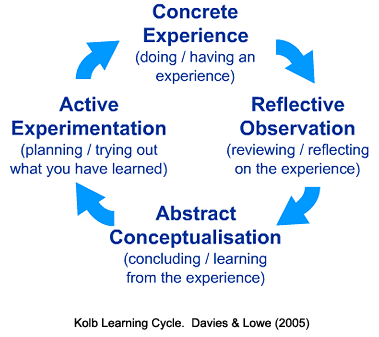
Kolb Learning Cycle. Davies & Lowe (2005) Rationale for Techniques and Their Relevance to Learning Objectives
Every activity in this lesson guides students toward the objectives of engaging in a first-meeting conversation, asking and responding affirmatively or negatively to yes/no questions, and knowing what questions Deaf people are likely to ask you when you first meet them and know how to respond appropriately. The book and DVD expose the students to the information and language modeling they need to know in order to practice toward learning these objectives; the recitation students do before class and during class–as well as the observation and explication–give them practice in applying the theory and language learned in the book and on the DVD. All the activities in this lesson are designed to relate to the learning objectives in ways that address various learning styles.
Resources
Nilson, L. B. (2010). Teaching at its best: A research-based resource for college instructors. Wiley. Kindle Edition.


 Daniel Greene