Author: Daniel Greene

  • Hyper Haiku: Inspired Meditations in Hyperlinked Haiku 俳句

    Hyper Haiku: Inspired Meditations in Hyperlinked Haiku 俳句

    Hyper Haiku 俳句

    Inspired Meditations in Hyperlinked Haiku

    Purpose:

    I created this site to explore the possibilities of hyperlinking haiku poems, knowing that the medium of hypertext would encourage me to free-associate and be more prolific. I am interested in your experience as a reader of these poems. Most poems will offer at least two hyperlinks, so you, the reader, may also free-associate by following the links that most appeal to you.

    What is Hyper Haiku?

    Haiku is a poetic form with one stanza of three lines; the first line has five syllables, the second line has seven, and the third line has five. As long as one follows those simple rules, the form gives great freedom for expression. Hypertext links pages and sections to each other through hyperlinks. Therefore, hypertext haiku, or “hyper haiku,” comprises haiku poems that contain hyperlinks to other haiku poems and so forth.

    A New Form:

    From what I have gathered, mine is the first site on the Internet to offer haiku poetry that follows the haiku form, makes grammatical sense, and contains hyperlinks within each haiku poem that link to other haiku poems. Here is a survey of the literature published in the field of hypertext haiku as of January 19, 2003, the date when this page was first published on the Internet.

    Haiku | Japanese Poetry
    This page praises the elegance (their word) of the haiku poem, and it offers several examples of translated haiku poems by “the four masters” Basho, Buson, Issa, and Shika. Several examples are given of haiku poems translated from Japanese into English. It is important to note that these translated poems do not fit the haiku form of five, seven, and five syllables in English; they did fit the form in Japanese, but the English translations of these haiku poems could not be considered haiku poems themselves. Also it is important to note that, while this page gives several examples of idyllic poems, it also shows us that haiku can be about the seedier aspects of the human experience. See the poems by Issa near the bottom of the page for examples of this.
    Haiku and Hyperku
    I found this site when I searched the Web for the word “Hyperku.” I had originally thought of calling my site “Hyperku,” but I wanted to see whether anyone else was using that word, and how they were using it. This author’s idea of “Hyperku” is haiku with links in it, like mine, except his links lead to offsite pages on related topics rather than to other haiku as mine do. After seeing his definition of “Hyperku,” I decided to be more cautious of naming my site “Hyperku,” because I didn’t want my brand of hypertext haiku to be confused with his. One thing I love about this guy’s page is that it’s written in XHTML and CSS, like mine, and it’s quite handsome as a result!
    Google Search for “hyperku”
    Besides the first two sites that came up in the search results (both related to the link listed above), I found that a lot of sites referred to a now-defunct music search site called Hyperku.com. Many of the pages in the search results that referred to Hyperku.com were in foreign languages. However, from what I could gather from my understanding of foreign languages and the few English sites that referred to Hyperku.com, it seems that the site had something to do with Audiogalaxy.com. What on earth Hyperku means to these people is beyond me! All I know is that I did not want my hypertext haiku site to be associated with these music sites, so I decided against calling my site “Hyperku.”
    Mel McClellan: Hyperhaiku
    A Google Search of “hyperhaiku” led to this page and the one below. Visually, this is an interesting Flash presentation; I like its use of graphics, movement, sound, and typography. It certainly fits the genre of multimedia. However, there are no links in the presentation, and no allowance for user interaction, so I don’t believe it could be considered hypermedia. In literary terms, the poem is not a haiku poem, for it does not fit the five, seven, and five syllable form. I would call this “multimedia poetry” rather than “Hyper Haiku.” Still, it’s interesting to see what else is out there.
    No Poetry
    This is, in my opinion, a fine specimen not only of good quality haiku writing, but also an effective use of the Flash medium. After seeing this, I certainly have no qualms about using the term “Hyper Haiku” for my site. The one thing the author’s “Hyperhaiku,” lacks is links within the haiku poem, an important distinction that makes hyper haiku “hyper.” My haiku poems not only contain links within them; they contain links to other haiku poems on my site.
    The Hyper Haiku
    I found this site after I had already completed mine. The author uses a strange, non-grammatical syntax (or lack thereof) in concocting poems that fit the haiku form. There is an abundance of hyperlinks in each poem, but there is no clear sense of connectedness between the words and poems. Rather, these hyper haiku seem to be random groupings of words mathematically assembled in the proper syllabic form. For me, the lack of cohesive syntax leads to a lack of semantic meaning at the textual level (surely each word has its semantic meaning intact, but the combination of words is so random as to be meaningless). I do not see such a haphazard conglomeration of words as haiku poetry, but I respect the author’s freedom to experiment, and I imagine that, while the experiment does not work for me, it may very well work for others. Even if an experiment doesn’t “work” for anybody, the experiment doesn’t “fail” as long as it demonstrates the results of trying something. As least this poetry fits the form of haiku and contains hyperlinks, which is more than can be said for much of the other “Hyper Haiku” out there.
    Moyayama
    This site is a fascinating international site of haiku poetry written in Russian and Japanese. It is a good thing to remember that the World Wide Web was meant to be written in all the languages of the world, not just in English. If your browser is able to render these pages in their intended alphabets, it is a testament to the multilingual power of HTML and WWW standards. This looks like a very interesting site. I cannot critique the poetry except to say that I don’t see any links in it, so I don’t see why it’s called “hyper” haiku, except that it’s presented in HTML. In any event, this is a good quality site.
    David Robertson’s Haiku Page
    This is a collection of haiku poems that fit the form and have, in my opinion, some literary value. They do not have any hyperlinks, so I would not call them “Hyper Haiku,” but they are good examples of haiku nonetheless.
    http://www.waxebb.com/main/haikuin.html
    This is an experimental site that haphazardly throws five, seven, and five words together to make nonsense poems. The poems do not fit the haiku form of five, seven, and five syllables, and they do not make any sense to me, but each word in each poem is a hyperlink that replaces the word you click with another word. Interesting experiment.

    My First Hyper Haiku Poems

    Drugs* are everywhere.
    Even the lights* inject
    a stimulating dose.
    *Lights are shining* bright.
    Why they shine I can’t divine.
    My eyes are quite blind.
    She called it *shining,
    said* Scatman. Danny’s finger
    said REDRUM! REDRUM!
    *Alcoholism--
    A disease that *tells me I
    *don’t have a disease.
    *Yo hablo ingles.
    Y yo hablo español.
    ¡Me gusta hablar!
    I am my *ego.
    I* need to get out of my
    own way. God help me!
    *Yo entiendo
    Mas que yo puedo* hablar.
    Olvido mucho.
    “I think I *can! I
    think I can!” Said* the little
    train that thought she could.
    Moi, je *parle français*
    et je parle anglais aussi.
    J’aime beaucoup parler!
    *Parisians treat you
    like the shit they don’t pick up
    when they walk* their dogs.
    *Hello. How are* you?
    I’m fine, thanks, and how are you?
    Fine, thanks. So, what’s new?
    All my friends *are gay!”
    (Absolutely Fabulous)
    “All—My—Friends—Are—Gay!

    An Invitation to Poets:

    If you have a 5–7–5 (syllable) haiku of your own based on one of the words in one of these haiku, please post it below as a comment. Thanks!

    P.S. I wrote this in a Hypertext class for my B.A. in English with a concentration in Communications and Media Study. Originally, each poem was on its own page, with at least one hyperlink to another page. You can see where the links were by the asterisk (*) at the end of word (forward link) and the asterisk at the beginning of a word (backward link).
  • Legal Requirements for Self-Employed Persons

    Please note I wrote this in May 2001. Facts may have changed.

    I did some researching lately on the requirements of self-employed status in San Diego, California (laws may be different elsewhere, of course!), and I found out a few things that I thought you might like to know. Some of these facts you probably already knew, and some may surprise you. First of all, did you know that every self-employed person doing business in the city of San Diego is required by law to own a Business Tax Certificate (BTC)? Yes, they haven’t done a very good job at getting the word out about this one, and I’ve never heard of anyone enforcing it, but apparently, anyone could walk up to you while you’re doing your freelance work and demand to see your BTC. The good news is that this BTC (formerly known as a Business License—ah, we’ve at least heard that term before, eh?) typically costs only $46 a year. You may find out all about the BTC, and download the necessary application forms in Adobe Portable Document Format (PDF), at http://www.sandiego.gov/treasurer/btax.shtml

    Second, some of us have had, at one time or another over the past several years, certain agencies or individuals tell us that, in order for us to claim independent contractor status, we were required by law to have to have a fictitious business name, incorporated status, a FEIN (Federal Employer ID Number), Worker’s Compensation Insurance, California State Disability Insurance, malpractice (professional liability) insurance, etc. Here is what I found out, by making several phone calls to local and state agencies and by looking up information on government web sites, one of which was (ref #1) http://www.sandiego.gov/economic-development/business/starting/tenkeysteps.shtml: (more…)

  • Interpreting or Transliterating?

    In previous installments, I’ve written about the importance of matching the Deaf speaker’s mastery of language, vocabulary, and register, especially when it comes to our ability to produce spoken English that is worthy of that speaker’s signed language. In my last, somewhat “controversial,” column, I wrote about the dilemmas we must face as interpreters when Deaf speakers produce signed English that is “wrong” or “broken English,” (as many second language speakers do). I believe that some of the controversy really turns upon the issue of whether we are voice interpreting or voice transliterating. This article will examine more closely the process that we might use to determine whether a Deaf speaker is producing an ASL message that must be interpreted or a signed English message that must be transliterated.

    I’d like to start off with the assertion that, “if it ain’t broke, don’t fix it!” Many of the sentences that Deaf people sign, either in ASL or some form of manually (and orally!) coded English, follow the same syntax as regular, spoken English sentences, and should be voiced exactly as they are signed. This means that we, as interpreters/transliterators, must constantly assess the speaker’s syntax and encoding system to ascertain whether each particular word, phrase, and sentence should be interpreted or transliterated. We must ask ourselves, “if I say exactly what they are signing (and mouthing), will the Hearing audience receive the same message as the Deaf speaker intended, or must I change the wording and/or phrasing in order to produce an equivalent message to the speaker’s intent?” My assertion is that, more often than some would have us believe, transliteration is the way to go. (more…)

  • Eulogy for Granny Greene

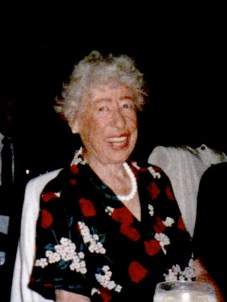
    Helene Kupferman Greene May 8, 1911–October 31, 1999
    Helene Kupferman Greene
    May 8, 1911–October 31, 1999

    My grandmother, Helene Kupferman Greene, lived to the age of 88, and is survived by her husband, Ernest Charles Greene (my grandfather); her two sons, Ernest Charles Greene, Jr. (my uncle Chuck) and Andrew William Greene (my dad); her two grandsons, Daniel James Greene (me) and Benjamin Furman Greene (my cousin); her dog, Whiskey II, and close friends and family members, most notably Elaine Patterson, who has cared for my grandparents ever since my grandfather’s stroke in 1985. Elaine became like an adopted daughter, and her two daughters, Michelle and Marta, became like granddaughters. Granny was so happy to finally have some girls in her family!

    My grandparents would have been married 65 years this February 2000. In addition to being a superb wife to her husband, and mother to her two boys, Helene Greene was a model, saleswoman, real estate agent, award-winning painter and interior designer. She was a woman of great passion, creative talent and patriotism. She loved her country, family, pets and friends dearly. She had a soft spot in her heart for animals and contributed generously of her time and money to organizations such as The Humane Society and many others.

    Granny had an uncanny memory for the lyrics of songs. She wasn’t the best singer in the world, but when she half-spoke/half-sang a tune, her face lit up, her outstretched hands swept the air, and her enthusiasm for the song filled the room with “razzle-dazzle.” I remember when I was a small child she would tuck me into bed and sing to me, “Sweetest little fella / everybody knows / ain’t no use in telling you / he’s mighty like a rose.” I will always remember Granny’s love for me. Believe it or not, I have a few vivid memories of my infancy, and I recall how she doted on me from day one. When I was very little, Granny used to bathe me in the deep brown porcelain laundry sink in her house on Kensington Court. I also remember the interest she took in encouraging my artistic development. When I was about 5 or 6, she enrolled me at the Arts Academy in Kensington, where I learned acting, movement, and creative arts. Granny also helped me financially when I first went to UCLA right out of high school. When I was young, Granny took me shopping for clothing when she knew my mother couldn’t afford to get me new clothes, and she sent me to summer camp in the Adirondacks when I was 8 and again when I was 10.

    Granny didn’t have to take to me the way she did. When my mother met my father (adoptive father, technically), she had given birth to me a few months prior, as Granny would say, “out of wedlock.” My biological father had disappeared. Granny didn’t feel my mom would be right for her son. As she put it in her own words, “we did everything we could to fight the marriage, but once our son decided to marry, we did everything we could to support it.” I believe this is true. I remember how gracious she and Grandpa were, and have always been, to my mother. Granny was passionate about either approving or disapproving of what anyone did. I remember when I was about 4 years old, my mom and Granny had a fight on the phone, and Granny got angry with my mom and shouted, “Well then you’re a bad mother!” But it wasn’t 30 seconds later she called back and said, “I shouldn’t have said that. You’re not a bad mother at all.” My mother has her faults, but has been a marvelous mother to me. Granny and Grandpa were probably right about the marriage, though. My mom and dad used to fight so much, I remember (and Granny remembered too) that, when I was about 3 or 4, I asked Granny, “If Mommy and Daddy keep fighting, can I come live with you?” Luckily, my parents divorced when I was five. I went off to live with my mother, but my dad, along with Granny and Grandpa, remained true to me as ever.

    Skipping ahead several years, I came out to my grandparents when I was 16. Within a year or two of receiving the news, Granny started going to the Parents, Family and Friends of Lesbians and Gays group at the Unitarian Universalist church. She eventually brought Grandpa and helped to bring him around to accepting me as well. I am eternally grateful to Granny for this. I’m also grateful that, soon after I told her I was gay, she showed a bold and loving interest in my health. One day, as we were out for a ride in the golf cart in Sun City, where Granny spent the last 19 years of her life, she said, “you know there are kinds of sex that are safe and kinds that aren’t, right?” I said yes, and she just took my hand in hers and said, “Good. I just want to make sure you’re having the safe kind.” For several years now, Granny’s farewell to me has been, “Be good! And if you can’t be good, be careful!” I’m happy that, with my family’s love and concern, and my own self-protection, I have indeed been careful and have not only been blessed to have a grandmother at the age of 32, but also—thank God!—to be able to bury her, rather than vice versa as happens too often these days.

    Granny was up front and demonstrative with people, for better or worse. She could be a terror with waiters! I do recall, however, that she made friends everywhere she went. Whenever she took me with her on her errands, the shopkeepers who knew her would light up and shout, “Mrs. Greene!” The ones she didn’t know, she got to know. Speaking of errands, Granny used to keep her entire household in mint condition. The moment a button fell off, or a bit of yarn became unraveled, or she realized a lamp needed a new finial (I never even knew what a finial was until Granny showed me)—off she would go on her errands. Whether it was a chestnut brown leather button to match the buttons on a cashmere cardigan she had bought in London or a piece of lavender wool thread to patch up a needlepoint pillow she had made, she was one of the most resourceful and optimistic people I’ve ever known. She would either find it, find out where to order it from overseas, or she would invent a brilliant alternative. The words “shy” or “quitter” never, ever applied to Granny! In terms of her love, she was always demonstrative of that with me. I can’t count the times she took my hand in hers, and looked me straight in the eye, locking in on my gaze, and smiled, saying, “You know I love you very, very much. You know that, don’t you?” I’d always say, “Yes, Granny, I know. I love you too!” Because of these many expressions of love, I feel complete about Granny’s death. I spoke with her on the phone a few weeks before she died, and we once again expressed our love for each other. We had our share of “bones to pick” over the years, but we always picked them clean. I have no regrets.

    I have Granny to thank for instilling in me a love for foreign languages and a respect for the proper use of my own language. Granny and Grandpa traveled all over the world, and they studied the languages of the places they went before they went there. One time, when Granny and Grandpa had traveled from France to Italy, Granny ordered a piece of cake after dinner in a fine restaurant. The only problem was that she used the French word for cake, “ gateau”, which sounds just like the Italian word for cat, “gato”! I wish I’d been there to see the horrified look on the face of that waiter! Granny once told me a joke about cats and dogs: a mother cat is walking down an alley with her three little kittens. Suddenly, from around the corner bounds a bulldog, baring its teeth and growling at the cat and her kittens. The mother cat, wise as she was, opened her mouth and bellowed, “Woof! Woof!” The bulldog put its tail between its legs and went running away, yelping. The mother cat turned to her kittens and said, “Now, children, you see the advantage of learning a second language!” Not only did Granny love foreign languages; she loved her own. Hardly a soul in her midst could escape her grammatical corrections. If anyone were unsure as to whether to use I or me, he would be sure to find out the right way when Granny intoned, in a dignified and certain voice, “them and me,” or “they and I.”

    Last but certainly not least; I must mention that Granny was very patriotic. She lived through the depression and both World Wars. In her last years, she had extreme difficulty moving around, sitting down, and getting up. She also lost a lot of her short-term memory and her ability to discern the past from the present. The last time I was over for a visit, we were watching a videotape of songs from the WWII days, and one of the clips showed an announcer introducing Kate Smith, “singing a new song!” Granny beamed with glee, watching the black-and-white television screen, and exclaimed, “Oh! A new song!” The song was “God Bless America.” Before Kate Smith could finish belting out the third word—America—Granny stood bolt upright with her hand over her heart, matching Kate word for word! This is my last vivid memory of seeing my grandmother in person, and it is one I will cherish forever.

    Those who would like to make a donation in my grandmother’s name should send a check to their local chapter of The Humane Society. Or volunteer!

    Here is a list of some of Granny’s favorite things:

    • Scottish Terriers (she had four in a row: Meg, Tammy, Whiskey, and Whiskey II)
    • Frogs (she had an extensive collection of figurines, including the Lalique frog and the Waterford frog)
    • Tab and Cheez-Its (a favorite afternoon snack)
    • Bagels and cream cheese with Nova Scotia smoked salmon, capers, lemon juice, and freshly ground pepper
    • Tanqueray and Tonic (in a restaurant, she would order a shot of Tanqueray gin, a small bottle of tonic water, a tall glass with ice, and “lotsalime.”)
    • Häagen Dazs coffee ice cream
    • Show tunes and pop songs
    • Hawaii
    • Navy blue

    (These are some of my favorite things too, only I’m not partial to Scotties, and I don’t drink cola.)

  • Correcting the Message

    A while ago, a colleague of mine made an interesting interpreting choice that got me to thinking about how much we should “correct” the signed messages we voice in English. As my team person was voicing, the deaf client misused an English idiom, and my team person voiced the English idiom in the same “broken” way the deaf person had signed and mouthed it. The hearing people in the room softly chuckled, not only because the deaf person had said something funny, but because the way s/he said it was funny as well. I will point out here that the deaf person was taking a turn speaking in a group in which the register was casual, and the deaf person was using a combination of ASL and PSE with a good deal of semi-audible mouthing. “Interesting choice!” I thought to myself, as my ears pricked up when I heard this “broken” English coming out of the interpreter’s mouth. Why did the interpreter choose not to “correct” the deaf person’s English? Is it our job to interpret any and all signed messages into perfect English, no matter how they are signed? Perhaps not, I thought, and I’ve been thinking about this issue ever since.

    Let’s take the above scenario and place a hearing immigrant in the deaf person’s place. Let’s take the interpreter out of the picture as well, because in the above case I believe it can be said that the deaf person did not need the interpreter so much to bridge languages as to bridge communication modes (from aural/oral to visual/gestural). The immigrant is likely to speak English like a foreigner and occasionally misuse English idioms (sometimes to charmingly humorous effect) just as the deaf person did. The native members of the group might softly chuckle and might, perhaps, offer the correct English idiom to the foreigner, so as to teach them the right way to say it. Or perhaps they will try to be polite and not correct the foreigner’s speech. The immigrant either learns the correct idiom or not. Either way, a natural process has occurred among people whose respective languages have come into contact with each other. The natives acquire a natural understanding of the foreigner’s level of familiarity with English, and the foreigner may or may not acquire a better familiarity of English through the feedback s/he receives from the natives. There is no intermediary present to smooth out all imperfections and create a false sense of the foreigner’s fluency in the natives’ language. Without the intermediary, mistakes come to light, and the participants are empowered to make choices based on this knowledge.

    (more…)