Found a relevant rubric today on iRubric for a French Oral Exam that I edited to make it an ASL Interactive Exam. This is what it looks like. Click the picture to jump to the rubric page.
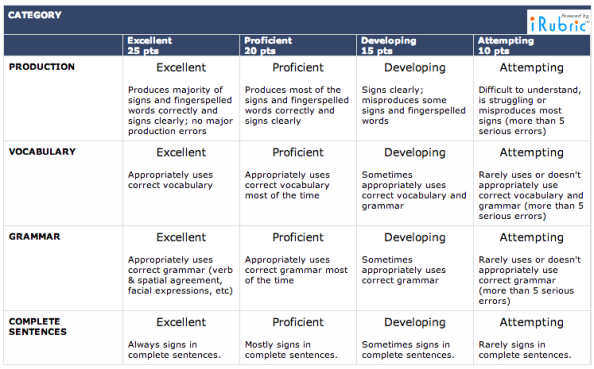
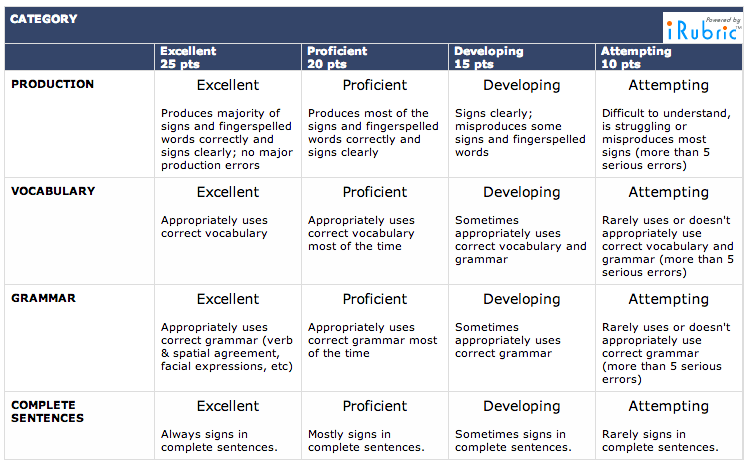
Found a relevant rubric today on iRubric for a French Oral Exam that I edited to make it an ASL Interactive Exam. This is what it looks like. Click the picture to jump to the rubric page.
Dear gentiles, when you say Merry Christmas and I say Happy Chanukah, don’t cheapen it by saying, “Oh yeah, and Happy Kwanzaa or whatever.”
First, there is the matter of sincerity. Chanukah is a Jewish holiday that predates Christmas. Kwanzaa is an African-American holiday that started in 1966. I don’t know if I look Jewish, but I certainly don’t look black. When you lump Kwanzaa in with Chanukah I think that you think I am just saying Happy Chanukah to be PC, and that I don’t actually mean it sincerely. Here’s the truth: I don’t say Happy Chanukah to be inclusive or politically correct; I say it because celebrate it.
Second, there is the matter of timing. When you wish me a Merry Christmas and it’s not December 25th, it’s not actually Christmas day. When I wish you a Happy Chanukah, I am doing so on one of the eight days of Chanukah I am actually celebrating that day. When you wish me a Happy Kwanzaa, you are wishing me a happy holiday that isn’t even celebrated until the day after Christmas through New Year’s Day. If you want to wish anyone a Happy Kwanzaa, do so when it’s actually being celebrated.
The best response to Happy Chanukah? “Thank you.”
P.S. For clarification: I don’t go around wishing people Happy Chanukah, but when someone wishes me a Merry Christmas during Chanukah, I say, “Thank you! And Happy Chanukah!” Sometimes I say, “Thank you, and I’m celebrating Chanukah today.” I try various responses, but I prefer to acknowledge my celebration of Chanukah rather than just saying nothing about it. I suppose I am trying to make a statement, but I’m also sincere.
I know more than I think I know, and I can do more than I think I can do.
These words came to me in a dream, and I woke myself up this morning by speaking them in my sleep.
Review day is not for me to speed-teach everything we’ve learned.
Love it! Instead, The teacher writes homework section numbers on different places on three boards in the room and says:
Go to where you want to get or give extra help on those sections.
The teacher then walks around the room to keep students on task and help out where needed.
I’m stealing that!
I have a new respect for Deaf people who take the time to sign with ASL students. Having more respect for Deaf people and more creativity in how I express myself is making me a better Deaf community member.
Well, maybe not wrong, but there are things I never knew, such as that Y is considered a down letter; that is, Y is made by tilting the palm downward. I’m sure this is not a hard and fast rule; in fact, I can see even on the Signing Naturally DVD the language models do not always sign Y that way. Still, I never knew it ever tilted down at all. Now I see it in the way I and other signers spell the lexicalized #style and #yes. I also never knew that the sign WHEN meant what day, not what time. Again, I’m sure this is not a hard and fast rule, but I never knew it was a rule at all. Those are just two examples of several. Learning how to refine my signing is making me a better interpreter.
Since many of the interpreting students and working interpreters I teach have learned ASL with the Signing Naturally curriculum, I have a better idea of what they were taught. Knowing what my students have learned is making me a better interpreter trainer.
 Daniel Greene