Blog
-
Happy end of Passover 2012 / Pesach 5772

We held a little seder at home the first night. 
Sunday morning I had some charoset with a matzah covered with dark chocolate cream cheese. 
Sunday night Andy made a delicious matzo ball soup. 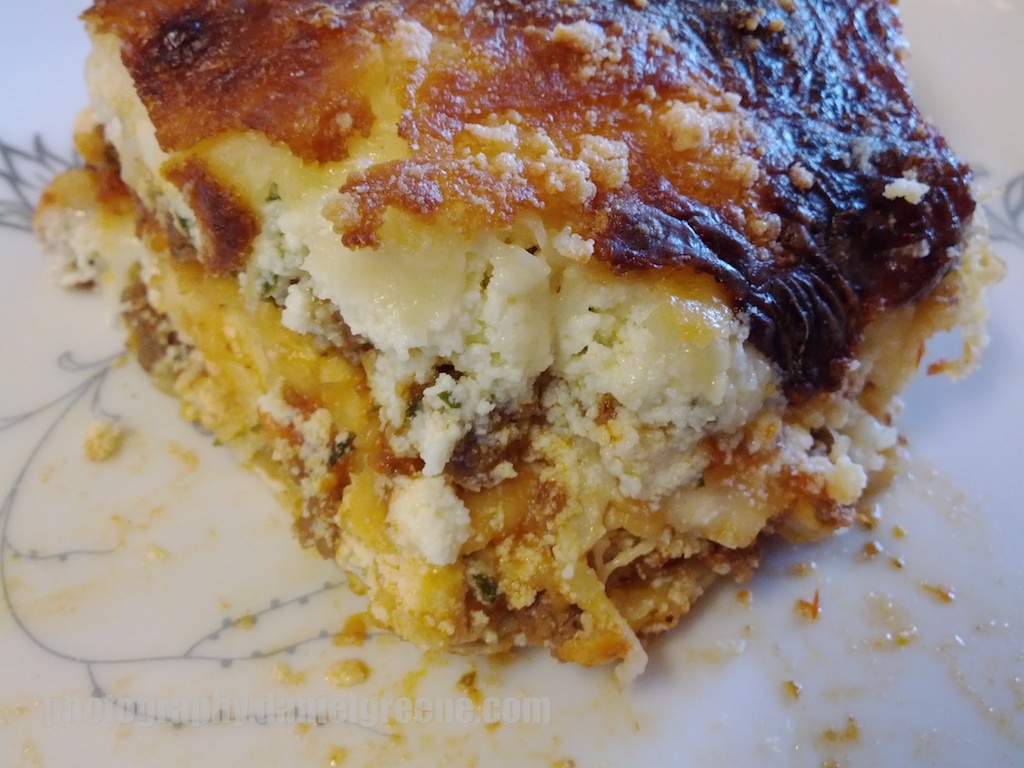
Tuesday night Andy made a sumptuous lasagna with matzah instead of noodles. It had beef in it (my idea), so it’s meat and dairy together, but that’s how we roll! 
Friday I made a lemon sponge cake from a recipe on a canister of Manischewitz potato starch. (Friday night I drenched it in an icing made of lemon juice and powdered sugar. Even yummier.) I’m not orthodox about the way I celebrate holidays. There was the hamburger in the lasagna. Heck, on some Passovers I’ve breakfast on eggs, matzah with butter on it, and bacon. Once in a while, I give into a craving, mix meat and dairy, add bacon, and have it on a chometzdik bun! As I Facebooked Thursday, “Eating a Sourdough Jack during Passover is wrong in so many ways… but it feels so right.” I do try to avoid “cheating” for the sake of observing the holiday, but when I give in, I don’t feel guilty; I just joke about it. The way I see it, even if I’m breaking tradition and joking about it, I’m acknowledging the tradition. The stomping of feet, the smell of sweat breaking out on flushed skin, the fear and hope of people who grabbed what they could and ran out of Egypt without even time to let their dough rise– these “memories” are with me. One might ask, “If you’re going to break the commandments, why even bother?” Well, I would rather observe the holiday by mostly abstaining from chometz (leavening) than by not abstaining at all. This was our Pesach, and I enjoyed it!
-
Found a new site: bab.la language portal
A helpful tool for translators because it lists many possible contexts in which a word or phrase means different things
-
Resources for ethics: Ethical wills (ASL video)
Fulfillment of an assignment in Western Oregon University’s course “Teaching Ethics & Professional Practice” in the Master of Arts in Interpreting Studies program with an emphasis in Teaching Interpreting. Our task was to find resources to help us in assessing our own ethics and teaching ethics to others. My contribution to my cohort’s resource list was three resources about ethical wills:
- Genesis 49: 1–33 and Deuteronomy 32: 46–47
- These Biblical passages are early examples of “ethical wills.” In Genesis, the dying Jaakov (Jacob) lays out for his sons what he sees will “befall” them based on what he thinks about their ethics; also, he expresses his prayers of blessing to his chosen son and the wish that he be buried with his ancestors. In Deuteronomy, the dying Moshe (Moses) instructed the people Israel to observe the commandments and teach them to prolong their lives and the lives of their children in the Promised Land (of Jordan).
- Medieval sourcebook: Jewish ethical wills, 12th & 14th centuries. Internet History Sourcebooks Project. New York: Fordham University. Retrieved from http://www.fordham.edu/halsall/source/jewish-wills.asp
- Here are translated texts of ethical wills given by two dying Jewish men in medieval times. These ethical wills show the ethics they wished their children to embrace in their lives.
- Obama, B. (2009, January 18). A letter to my daughters. Life Legacies. Retrieved from http://life-legacies.com/ethicalwills/samples.html#3
- Ethical wills don’t have to wait until death. They can also be given by people at important junctures in their lives. This ethical will, or legacy letter, was written by Barack Obama to his daughters as he prepared to take the place of President of the United States. (A good time to write a will if ever there was one.) I like this web page because it has five other legacy letters from other people as well.
-
A sample video of English-ASL platform interpreting
I’m posting this for anyone who is curious to watch an English-ASL interpreter at work on stage with a speaker. Dr. Johanna Blackley and the Honors Forum coordinator at Mesa Community College were kind enough to let me share this video my interpreting partner took of me with my phone. I asked my team to record it so I could use it for self-assessment in an interpreting studies class I was taking in graduate school. I’m sharing it because I think it’s important for interpreters to see real examples of other interpreters’ work — the hits and misses in this imperfect thing we call interpretation. Most of this sample is dialogue during the Q & A portion at the end of Johanna’s lecture.
Oh, and one more thing– (more…)
 Daniel Greene