Category: Language

My observations about grammar, language, and linguistics

  • Bimodal interpreters, not just sign language interpreters

    Sign language interpreters are spoken language interpreters too

    To talk about our work, it helps to have efficient terms that accurately define it. Typically, we ASL/English interpreters call ourselves “sign language interpreters,” while we call (for example) Spanish/English interpreters “spoken language interpreters.” Yet signed language is only half our language pair; the other half is spoken language; therefore, we are also spoken language interpreters.

    How to distinguish, then, between interpreters who work with two spoken languages and interpreters who work with a spoken language and a signed language? Saying “signed-spoken” and “spoken-spoken” is a mouthful. Luckily, there are better terms for this comparison: bimodal and unimodal (Emmorey, Borinstein, Thompson, & Gollan, 2008). What we share with unimodal interpreters is that we are bilingual. What sets us apart is that we interpret between two modes: signed and spoken; therefore, we are bimodal interpreters.

    Visual language interpreters are aural language interpreters too

    I like the name of the Association of Visual Language Interpreters of Canada better than the Registry of Interpreters for the Deaf because we are interpreters for the H/hearing as much as we are interpreters for the D/deaf. Yet the term visual language interpreters fails to acknowledge that we are also aural language interpreters. This is where bimodal is more accurate. We interpret in two modes: call them aural and visual or audible and visible; either way, we are bimodal interpreters.

    We are also bimodal when we do sight translation; i.e., interpreting from written text to signed language for those who have difficulty reading. An interpreter might also do tactile sight translation for a Deaf-Blind person who does not read Braille or cannot obtain a certain document in Braille. There are many different ways we facilitate communication; not all of them are visual, but they are all bimodal.

    We need terms as inclusive and specific as our work

    Bimodal is an accurate and comprehensive term for what we do to facilitate communication between D/deaf and hearing people. We, as a collective of individuals, serve a diversity of deaf (not always Deaf) consumers using a variety of methods to make audible language visible and vice versa.  Some use American Sign Language (ASL); some use manually coded English (MCE), a.k.a. pidgin sign English (PSE), or, preferably, contact language; some use oral methods such as mouthing and gestures; still others use cued speech. Whatever opinion people have of these modes of communication, there are D/deaf people who use them, and there interpreters and transliterators who serve those D/deaf people and their hearing interlocutors. Not all of these methods are bilingual, but they are all bimodal.

    To be even more accurate, some of us sometimes interpret using audible, visible, and tactile methods between hearing, D/deaf, and Deaf-Blind people, so when we do that, we are trimodal interpreters.

    Let scholarship inform our practice

    The demand for bimodal interpreting services has always outpaced the supply of available practitioners, and consequently, federal funding has primarily been directed at increasing the number of available practitioners, not on research and development. As a result, we contend that the field has adopted and maintains a “culture of practice” rather than a “culture of scholarship.” (Nicodemus & Swabey, 2011)

    There is a time and place for specialized terminology. I am not suggesting we start calling ourselves bimodal interpreters outside of the profession. I do not plan to say to hearing clients, “Hi, I’m your bimodal interpreter!” I will continue to call myself an interpreter first, and an ASL/English interpreter second. I might even slip and call myself a sign language interpreter if I am careless. However, when talking about our work vis-à-vis the work of interpreters who work in spoken languages only, I would like to see us compare bimodal interpreters with unimodal interpreters instead of sign(ed) language interpreters and spoken language interpreters. Fellow interpreter educators could start by introducing the term bimodal bilingual, if they have not already done so, and fellow interpreters could use the term in professional discussions. It would be ignorant to use the same terminology we have always used when scholarship informs us of a better option. We are professionals, and part of professional practice is scholarship. I believe it is time for us to take a more global, research-based view of what we do, and start talking about it in ways that demonstrate greater awareness.

    References

    Emmorey, K., Borinstein, H. B., Thompson, R. and Gollan, T. H. (2008). Bimodal bilingualism. In Bilingualism: Language and Cognition 11(1), 43–61. Retrieved from http://www.ncbi.nlm.nih.gov/pmc/articles/PMC2600850/

    Nicodemus, B. & Swabey, L. (2011). Bimodal bilingual interpreting in the U.S. healthcare system: A critical linguistic activity in need of investigation. In B. Nicodemus & L. Swabey (Eds.) Advances in Interpreting Research. Inquiry in action, 241–259. Philadelphia, PA: John Benjamins. Retrieved from https://www.academia.edu/5270051/
    Bimodal_bilingual_interpreting_in_the_U.S._healthcare_system

  • Fun with French — a language learner’s laughter

    Fun with French — a language learner’s laughter

    I just got home after staying in Quebec for a week, and I encountered some words and phrases I found very funny. Here are some of my travel notes.

    Life is a Cabaret — And so is a tray!

    This tray is a cabaret!
    This tray is a cabaret!

    When I ordered two coffees at a Starbucks, they asked me if I wanted a cabaret — « voudriez un cabaret? » Like “Come to the cabaret?” I thought. No, it turns out a cabaret is a little tray– that molded cardboard thing you can put four cups in. Who knew?

    Just Want to Do It

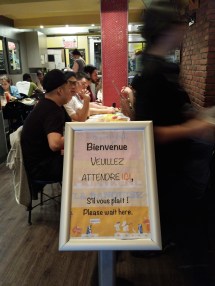
    "Bienvenue - VOUILLEZ ATTENDRE _ICI_, S'il vous plaît! Please wait here." - a sign at the front of a restaurant we went to in Montréal
    “Bienvenue – VOUILLEZ ATTENDRE _ICI_, S’il vous plaît! Please wait here.” – a sign at the front of a restaurant we went to in Montréal

    There is a polite way of telling someone to do something in French; you tell someone to want to do it. For example, « veuillez attendre ici » means, literally, “want to wait here.” Of course, a more equivalent translation is “please wait here,” but I think the literal grammar is very funny.  The closest analogy I can think of in English is a sentence like, “You will want to be on time tomorrow.” This is something a boss might say to an employee, the implication being “if you want to keep your job.”

    Daddy Has Reason

    Jane Wyatt & Robert Young - Papa A Raison
    Jane Wyatt & Robert Young – Papa A Raison

    We were talking with the friends we were staying with about US TV shows in Canada and Canadian TV shows in the US. (For example, did you know that Rookie Blue is a Canadian show?) Well, the conversation got around to classic US TV shows translated into French, and one of our friends said his mother looked like Jane Wyatt in “Papa a RaisonDaddy Has Reason?” I had to laugh at his quick translation, and thank God I knew French, because I realized he was talking about Father Knows Best. See, in French, avoir raison (literally to have reason) means to be right. It makes sense that the French would translate knows best to a raison. It just sounds funny in English to translate it back. I suppose they could have translated Father Knows Best to Pere Sait Meilleur, but I guess it doesn’t sound as good or have quite the same flavor as Papa A Raison. Anyway, I got a great laugh out of that. Daddy has reason!

    Rhyming Neighborhoods

    One There Thinks

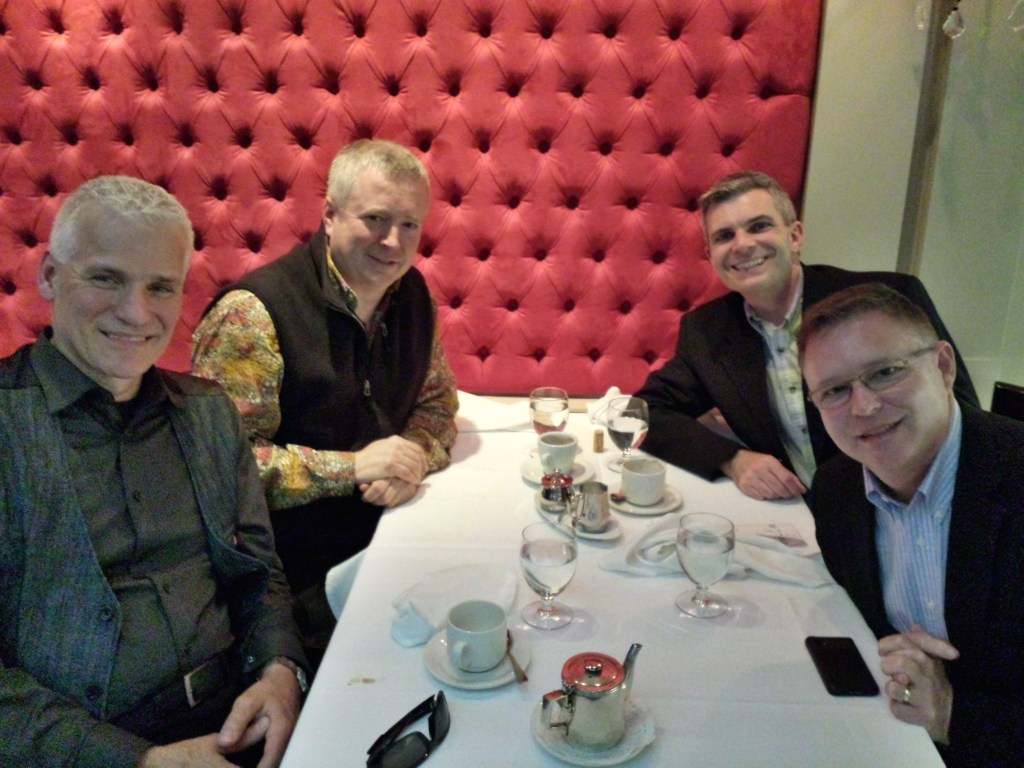
    Richard, Louis, Daniel, & Andy at Le Saint-Amour
    Richard, Louis, Daniel, & Andy at Le Saint-Amour restaurant

    Our waiter at this beautiful restaurant in Quebec City cracked me up when he gracefully approached out table after we had eaten our main course, and said « Maintenant on arrive tout doucement à la croisée des chemins — fromage ou dessert? » It was funny in itself that he said, “Now we have gently arrived at a crossroads: Cheese or dessert.” What I got even more of a kick out of is what he said after we asked some questions of him and each other: he took his leave graciously by stepping back with a sweeping hand gesture to us, smiling and saying « On y pense » (literally, one there thinks). I had never heard this expression before, but I knew enough about French to know that the word y means more than just there; it can also mean on it. Thus, he was ever-so-suavely saying, “one thinks on it.” I just love the way people contrive language to tell you to do something without telling you to do it (like veuillez). Our waiter really was a sweet and funny guy — not the American stereotype of the stuffy, prissy French waiter.  I could imagine an English waiter saying, “I’ll leave you gentlemen to think upon it at your leisure,” but how much more elegant is it to convey the same meaning in three syllables? On y pense. Love it!

    Who Woulda Drunk It?

    qui lait cru!?! fromagerie - who would've thought!?! cheese store
    qui lait cru!?! fromagerie – who would’ve thought!?! cheese store

    When we went with our friends to a huge farmer’s market Marché Jean-Talon,  we walked by a fromagerie (cheese store) called Qui Lait Cru!?! One of our friends told me the name of the store was a jeu de mots (play on words) of the phrase qui l’eu cru!?!, which means who would’ve thought!?! What is different is the word lait means milk. Pretty funny! Well, allow me to suggest an equally funny translation for them in English: Who Woulda Drunk It!?! See, it rhymes with who woulda thunk it, an even quirkier way of saying who would’ve thought, and drunk it refers to the milk. In other words, who would have drunk the milk when we could make such delicious cheese out of it? You’re welcome, qui lait cru. I take PayPal. 😉

  • Of course there are dialects of ASL. Why wouldn’t there be?

    Of course there are dialects of ASL. Why wouldn’t there be?

    Someone on Google+ today asked me what I thought of the article All Things Linguistic — Dialects of Sign Language: Black ASL. I responded with the following comment, which I felt should be shared here:

    Yes, I’m familiar with this. The segregation of black Deaf children in black Deaf schools, and the segregation of black and white people in general, led to a distinct variety of ASL. The cultural and linguistic heritage of that dialect endures today.

    When I was a video relay service (VRS) interpreter, I saw Deaf people call in from all over the US, and I learned a lot of different signs I had never seen before, since there are so many regional varieties. I saw difference in pace, rhythm, signing space, syntax, words that were fingerspelled instead of signed, and vice versa.

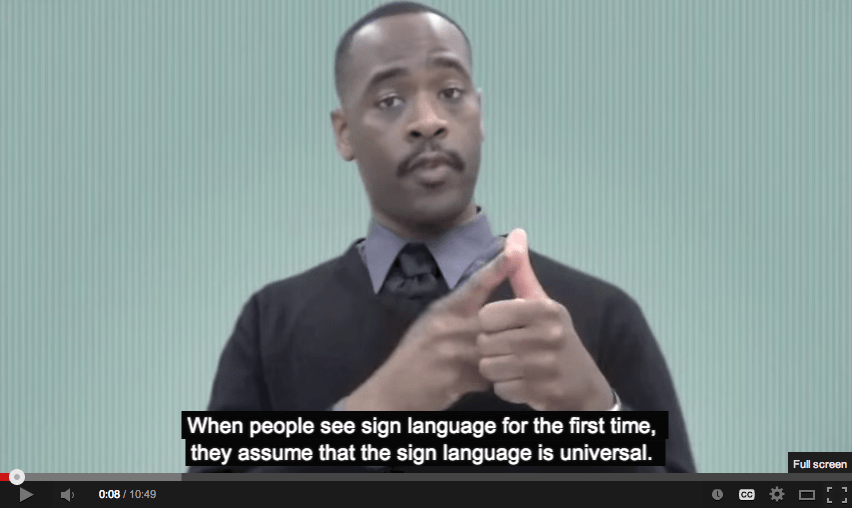
    I wish this would not come as a surprise to hearing people who know nothing of ASL, because they should understand that ASL is as varied as spoken language, and emerges and evolves organically among language communities. Instead, it seems most hearing people assume that ASL is a fixed system invented by hearing people and taught to Deaf people all over the world. They also seem to assume that Deaf people take what is “given” to them without question or alteration. Of course they don’t realize they assume this, but the way they talk about it, they do. For example, when I tell them I am an ASL interpreter, they assume I teach ASL to Deaf people, as if Deaf people needed a hearing person to teach them how to communicate. They also say things like “why isn’t it universal? It should be!” I ask them “why isn’t English universal?” They seem to take for granted that hearing people have the sovereignty to create and use their own languages, yet they think Deaf people don’t create their own ways of communicating, and should be made to communicate the same way all over the world.

    I’ll leave you with the video that inspired the original article:

  • Translations for CHA-HEAD other than ARROGANT

    There is a sign in ASL some call CHA-HEAD because “cha” is the mouth morpheme used in ASL for something big, and the sign for BIG is made around the head level to indicate a “big head” (figuratively speaking). The formal gloss for this sign is ARROGANT (glosses are conventionally written in ALL CAPS). Since ASL has no written form, when people want to write about ASL, or talk about it in English, they assign glosses to signs. The benefit of these glosses is they give us a way to transcribe ASL for the purposes of notation and translation. The drawback of these glosses is they tend to limit our translation of these signs that one gloss, rather than to what the signs actually mean in context.

    as any good interpreter or translator knows, words and signs in one languages do not always have single word/sign equivalents in another

    One example of a gloss that I believe limits our vocabulary is the gloss ARROGANT for the sign, well, let’s call it CHA-HEAD for lack of a better word other. The thing we might forget is that CHA-HEAD often doesn’t mean anything as extreme as arrogant. A few cases in point: I was interpreting a video relay call some years ago (and of the thousands of call I interpreted in seven years, this is one that stands out), and a Deaf brother signed to his hearing brother something to the effect of YOU CHA-HEAD TELL DAD. I (unfortunately) voiced, “it was arrogant of you to tell him.” The hearing brother said, “I’m not arrogant!” I realized at that moment is was my interpretation, not what his brother said, that he was responding to. I asked the Deaf caller to hold just a moment, and I explained to the hearing caller, “this is the interpreter— sorry about that interpretation. A better interpretation would have been, “you shouldn’ta done that.” I chose that interpretation on second thought because that’s what the Deaf person’s utterance “felt” like when I saw it; in other words, that was the sense of what the Deaf person signed. I had made the mistake of interpreting the form of the word I had been taught for that sign, and the translation was woefully off. When I really thought about it for a moment (and how many “moments” do we really have when we are interpreting a phone call?), I realized not only did the sign not mean arrogant; it really didn’t even translate to a particular word, but more to an expression.

    Another case in point, which brought this up for me recently: I was debriefing with a fellow interpreter, and I felt I needed to call them out on something they did on the job that I felt was less than appropriate (as I’ve said, I believe interpreting teams need to be blunt with each other for the sake of consumers. We were conversing in both our languages (as bilingual people often do), and I said, “I thought that was a little [switching to ASL without mouthing] CHA-HEAD.” My colleague said, “it wasn’t arrogant!” Now, you have to understand, this colleague is an intelligent, well-educated, and seasoned interpreter, so if they thought of the word arrogant when confronted with that sign, it tells me the connotation is well entrenched among ASL-English interpreters. What I said to them was, “well, I didn’t mean arrogant; I just meant kind of liberal [in the demand-control schema sense of favoring action as opposed to inaction].” I just felt that they had done something that overstepped an interpreter’s bounds a bit. Of course, that is arguable, and the point is not which one of us was “right” or “wrong”— the point is that my colleague took exception to my ASL sign because of the denotation assigned to it by the English gloss.

    A Thesaurus of Translations for CHA-HEAD other than ARROGANT

    Since the sign in question means so many things milder than arrogant, here is a list of translations with a range of meanings to match a range of situations. Note these are not all single words, because as any good interpreter or translator knows, words and signs in one languages do not always have single word/sign equivalents in another. These translations are context-dependent, and are not by any means suggested to be one-size-fits-all. Pick and choose what suits the situation. Here’s my list as of now:

    • presumptuous
    • to take it upon oneself to…
    • to go right ahead and…
    • to just…
    • familiar
    • forward
    • to overstep
    • overstepping one’s bounds
    • beyond one’s place
    • crossing the line
    • a bit much, don’t you think?
    • the nerve!
    • to have the nerve to…
    • ballsy
    • cheeky
    • brazen
    • bold
    • conceited
    • big-headed
    • full of oneself
    • taking liberties
    • inappropriate
    • to think [one] can just…

    I’m sure the list could go on, but that’s all I can think of at the moment. Do you have any other translations? Please leave a comment. Thanks!