
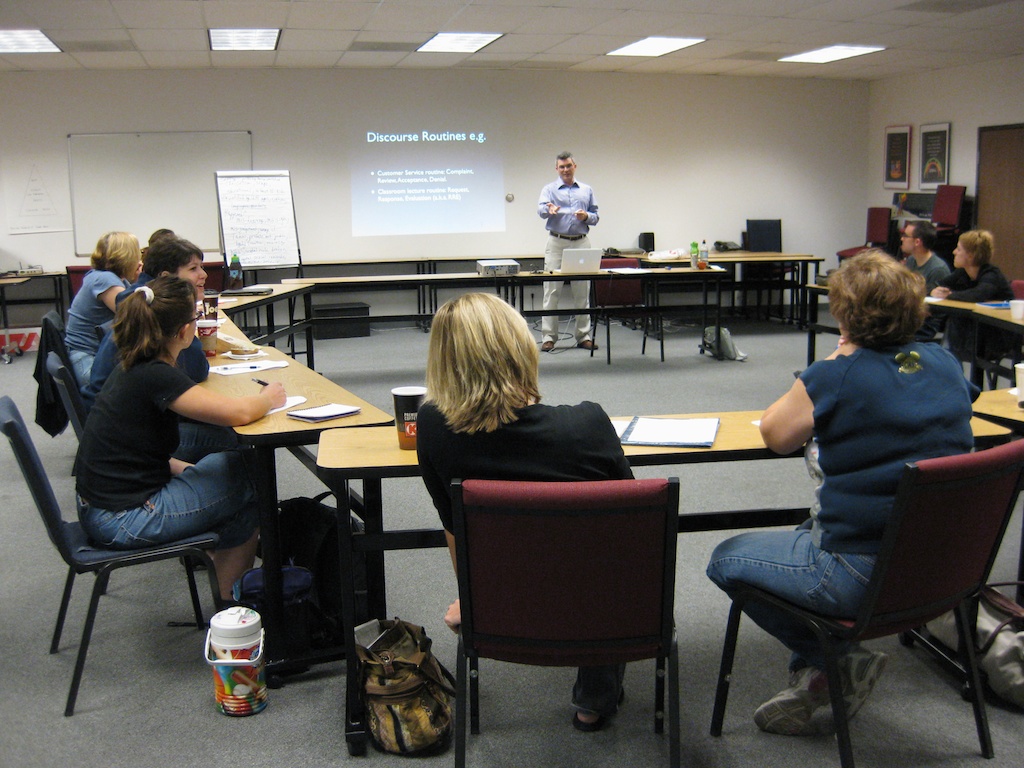
This Wednesday, July 4th, from 1–4 PM Arizona Time (same as PDT), I am excited to open my workshop to participants on a Google+ Hangout. Interpreters on Google+ have asked me when I would be offering a workshop online, and now I finally am. This workshop costs $30 USD and offers .3 continuing education units (CEUs) through the Registry of Interpreters for the Deaf Certificate Maintenance Program (RID CMP). CEUs are sponsored by the Arizona Commission for the Deaf and Hard-of-Hearing (ACDHH). We will webcast from the Desert Valley’s Regional Co-op in Phoenix, Arizona. The language for this workshop will be English. The onsite participants will be ASL/English interpreters yet the workshop is designed for interpreters of all languages. Also, although we will only be processing CEUs for RID members, anyone is welcome to join, and perhaps you can apply to your own programs for CEUs.
 Hangouts can hold up to 10 participants. I and a few onsite participants will take two screens, so there is room for up to 8 online participants. To register, please download the registration form and follow the directions. Note that Fostering Independence is the only online workshop at this time, and be sure to include the email address you use for your Google+ account. When Amerigo receives your registration, she will acknowledge your enrollment and you may send $30 USD plus PayPal fees ($31.17, if my calculations are correct) to my verified PayPal account. I will then add you to a private circle and invite you to join our Google+ Hangout at 1 PM Arizona Time on Wednesday.
Workshop Description
This workshop is held on Independence Day for a reason. The NAD-RID Code of Professional Conduct (CPC), Tenet 4, Respect for Consumers, admonishes interpreters to “Facilitate communication access and equality, and support the full interaction and independence of consumers.” Supporting consumer interaction and independence demands that we get out of the way when consumers don’t need us to interpret for them. Various models of interpretation have viewed the interpreter-client relationship in different ways, but do not focus much on the client-client relationship. This workshop will review some well known and lesser-known models of the interpreter-client relationship, examine the “Rescue Triangle,” and introduce a model of interpretation that focuses on the client-client relationship. Participants will have ample time to reflect upon their own professional practice and see how they may be sometimes standing in the way of their clients’ relationships with each other; participants will be guided to identify ways in which they can get out of the way of client-client relationships and foster independence.
Presenter Bio
Daniel Greene, BA, NIC Master, has been studying and practicing the teaching of ethics and professional practice in the Masters of Arts in Interpreting Studies/Teaching program at Western Oregon University for the past year. Since 1990, he has interpreted the gamut of settings including business, conference, education (pre-school to post-doc), medical, performing arts and video. His love of arts and literature informs his work, and his passion for elevating the interpreting profession drives him to study lesser-known aspects of interpretation and teach interpreters new skills.
 Daniel Greene