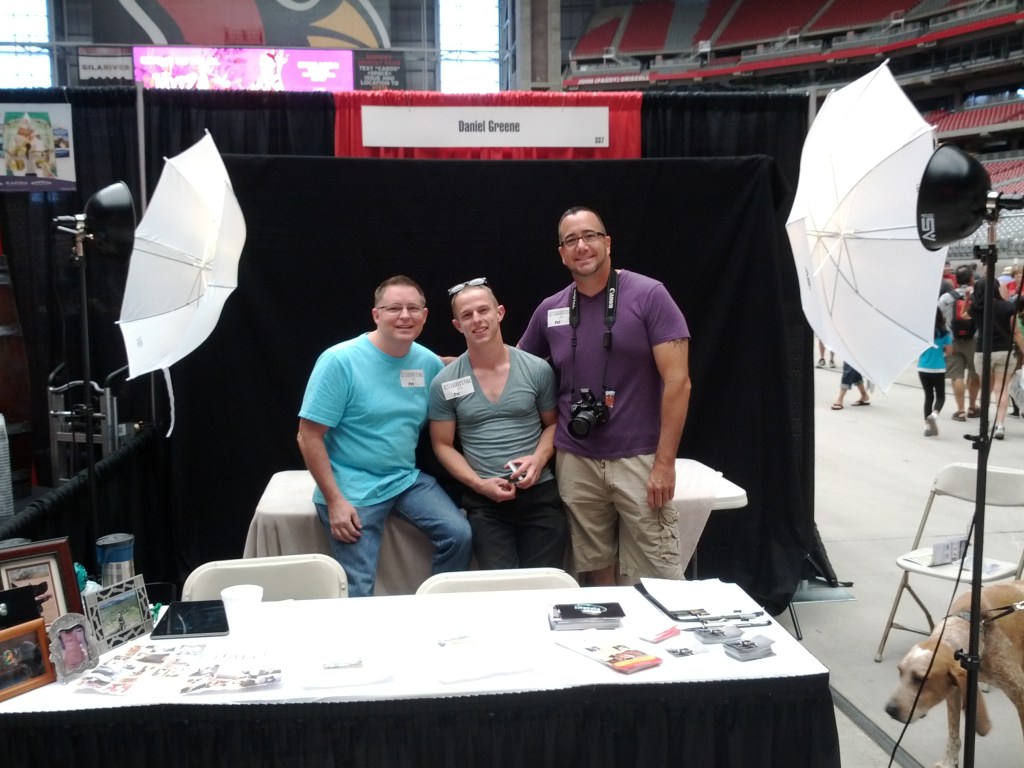
We did a brisk business at Phoenix Pet Expo last Saturday, photographing 65 sittings in 8 hours. At $5 per pet, with 50% going to HALO Animal Rescue plus extra donations, we raised $241.50 for charity. I had great fun meeting people and pets at my booth and taking photos around the Expo. Thanks to everyone who stopped by to have their photos taken and/or donate to HALO, and thanks to Andy, David, and Sean who volunteered to help with the event! More photos to come.
Blog
-
Thank God for good weather and bicycles!
Thank God for good weather and bicycles! I just had a great ride around the neighborhood in blissful 77° weather.
-
Two texts that inspire & inform my teaching & professional practice
My response to a homework assignment to reflect on texts (of any kind – books, articles, poems, videos, TV, movies, photos, paintings) that inspire and inform our teaching and professional practice. The two I picked were Dead Poets Society for teaching and Grey’s Anatomy for professional practice.
-
Fascinating post! I love it when interpreters & translators take charge* appropriately. I know in the ASL-English interpreting world, our Deaf consumers usually do no like it (to put it mildly) when Hearing interpreters “take control.” They see it as paternalistic, disempowering, and arrogant. However, there are times when it is foolish to do nothing, say nothing– especially when you are only dealing with human clients on one side of the language divide! I’m sure the documents weren’t offended that you told the American attorneys it was a waste of your time to translate them. You saved them a lot of time and money. I have saved people time and money by telling them a situation did not need two interpreters. I am an advocate of team interpreting, and I cannot work alone for more than 20 or 30 minutes of continuous speech, but when it’s really sporadic, I don’t need a team. To be fair, I would discuss this with the other interpreter to see which one of us feels they need the job. If they would have kept quiet about the surplus of interpreters, and I have reason to believe I will get work elsewhere, I will offer to be the one to turn back the job (I’m talking about repeating or continuous assignments).
Now, to your other issue: You didn’t just save them time and money; you used your knowledge to help them get what they wanted. This is a good ethical dilemma. I think most of us do this sometimes whether we know it or not, but occasionally it’s a decision we deliberate. I once interpreted a video relay call for an hour where the Deaf caller was trying to get some information specific to services to the Deaf, but no one she connected to or was transferred to was aware of the services they provide. I was well aware, because I had interpreted many calls to this company before. After a painful hour of keeping my knowledge to myself, I finally decided to do something. I said, “Excuse me for a moment,” in English, which made it sound like the Deaf caller had said it. I then suggested to the Deaf caller that they Google a specific string of search terms. They did, and they found what they had been looking for for an hour. I asked the Deaf person to please not tell the Hearing person I had told them. The Deaf person thanked me and understood my request, and simply said, “Don’t you people use Google to find information about your own company and help customers? I just Googled [such-and-such] and found it right away!” Luckily, in this case, the Deaf person felt no resentment at me for “taking control” because I really didn’t take control; I simply provided one client with information that would help them and not hurt the other client (after all, the Hearing client would get the Deaf client’s business if they just knew where to point the Deaf client). I was able to do this without saying to both parties, “Okay, hold on, people. I know the answer and this is what it is.” I have often wanted to do that as an interpreter, but I almost always bite my tongue / site on my hands. 😉
By the way, I armed myself with this tenet of the Code of Professional Conduct developed in cooperation between the National Association of the Deaf and the Registry of Interpreters for the Deaf:
2.0 PROFESSIONALISM.
Tenet: Interpreters possess the professional skills and knowledge required for the specific interpreting situation.
Guiding Principle: Interpreters are expected to stay abreast of evolving language use and trends in the profession of interpreting as well as in the American Deaf community.
Illustrative behavior 2.6: Judiciously provide information or referral regarding available interpreting or community resources without infringing upon consumers’ rights.
I felt my behavior was ethical, especially since the information I provided was specific to “available interpreting or community resources” and I didn’t infringe on anyone’s rights.
* I looked up the word “charge” just now to see if I wanted to use it, and this is the operative definition I found: “the responsibility of taking care or control of someone or something” (American Heritage Dictionary in Mac OS X). And look at the word “responsibility.” Rather than looking at it as a “burden,” I like to remember that it is the ability to respond! Also, “charge” can mean power. Power is not a bad thing if used for good.
Dear Colleagues,
We all have clients who at one time or another have asked us to translate materials that we know, or learn after reviewing them, are useless or irrelevant for our client’s objective.
One time I was asked to translate a Mexican court file that was close to forty thousand words. The client needed the translation to avoid that a client be prosecuted for crimes not included in the extradition order issued by the requested party. When I came on board to participate in the translation process, others had been involved for months (if not years) translating endless documents, international conventions, and case law. I must add that the American attorneys, although excellent and capable, were not very familiar with International Law. Because of my background as an attorney, from the time I joined the team, I was able to notice the uselessness of translating a bunch of documents…
View original post 225 more words
-
Resources for teaching development of professional practice
I made this video to fulfill an assignment in Teaching Ethics and Professional Practice at Western Oregon University’s MA in Interpreting Studies program with a concentration in Teaching Interpreting. The assignment was to share the process I went through to find materials to share in classes, in mentoring, or in my own work as an interpreter. Some of these resources were new to me; some of the resources I share in the video are recaps of what I have shared on this blog in the past few weeks. I am sorry I don’t have the time to transcribe and closed-caption the video for those who do not know ASL, but if you read my recent blog posts in addition to what is below, you already know what I was describing in the video. Here are the resources I describe:
Videos
United States Courts Federal Judiciary. (2010, September 23.) Nuremberg interpreter recalls historic trials [Video]. Retrieved from http://www.youtube.com/watch?v=cvY_1bMAZWY
Activities
Watching or participating in professional online discussion forum such as the #IntJC or #EPT Twitter chats (Interpreter Journal Club and Endless Possibilities Talks, respectively). I have participated in both in the past two weeks, and it has been beneficial both to me and them for spoken and signed language interpreters and translators to discuss their work with each other. For more info, see Interpreter joins the #IntJC Twitter form and Notes on “A Conversation with Translators.”
Websites
Greene, D. (n.d.) TerpTrans: An ASL-English interpreter/trainer on interpreting, transliterating, and translation. http://terptrans.com
Shameless plug for my own blog. Many potential and practicing interpreters have found the pages and posts in this blog to be useful, and I am working hard at making it ever more professional and global. Feel free to review it! I’m open to feedback.
Articles
Klemenc-Ketis, Z. & Kersnik, J. (2011, August 23). Using movies to teach professionalism to medical students. BMC Medical Education 11(16). Retrieved from http://www.biomedcentral.com/1472-6920/11/60

 Daniel Greene