Category: Communication

I got my BA in English with a concentration in Communications / Media Study. These posts represent my interest in those fields of study, including: Movies, Television, Websites, Blogging, HTML, CSS, Social Media, etc.

  • Google Video Shutting Down*

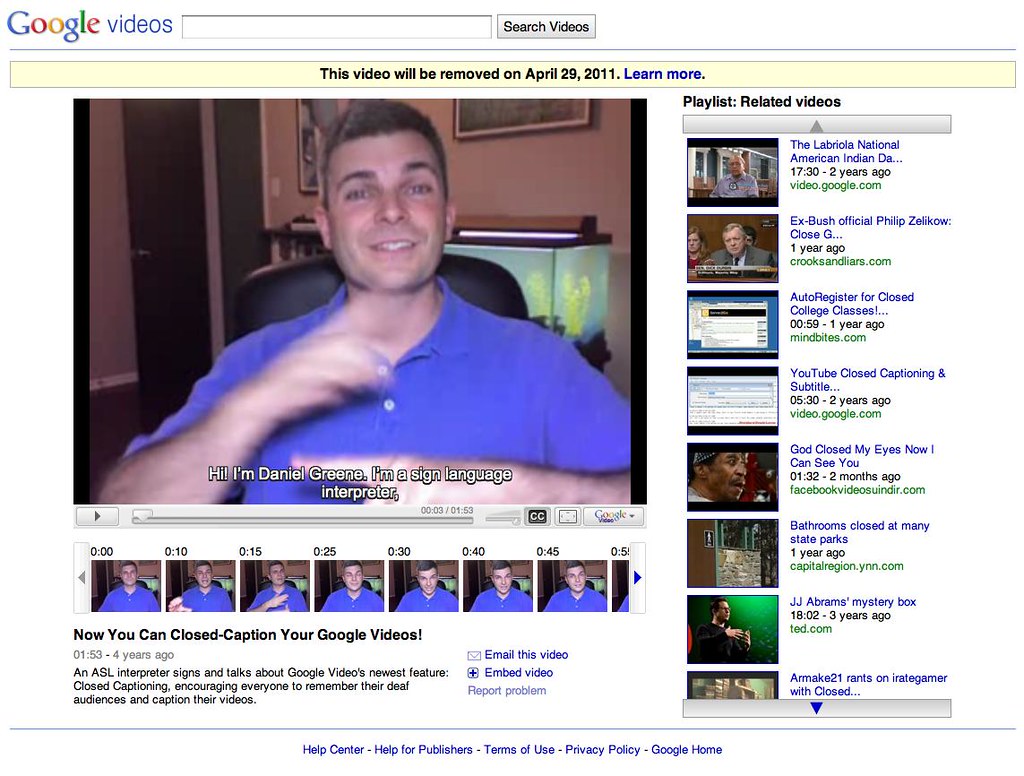
    Google Video Shutting Down

    *Google Video is shutting down as a content host but will continue as a video search.

    In case you ever uploaded a video to Google Video and didn’t get the memo that they’re shutting down, here’s a copy of the email from Google yesterday: (more…)

  • My Article on Vague Language (VL) Featured in RID Views

    My Article on Vague Language (VL) Featured in RID Views

    RID Views Cover Spring 2011My article “Interpreting Intentionally Vague Language” was featured in the RID Views, Spring 2011. If you read the article, or are already familiar with VL, I would like to know your thoughts on the subject, so please feel free to leave a comment on this blog post.

    In case you’re interested, I teach workshops on VL and other topics— and love to travel. 🙂

  • Changing the ways I use social media

    I have a feeling the latter half of the last decade is going to be remembered for how we rushed into social media: Flickr! YouTube! Twitter! Facebook! Foursquare! I know I rushed in— sometimes like a fool. In some ways, I’m glad I did; in other ways, I’m already looking back on the 2000s with the same disbelief as I’ve felt about other fads I can’t believe I followed.However, I’m not down on social media; I guess you could say I’m “down with it.” I’m just making some changes to the way I use it. Here they are:

    Flickr

    I once said I felt chained to Flickr. Well, I certainly don’t feel that way anymore. Coincidentally, I also haven’t had a photo in Explore in over a year. What I have realized, although I suspected it before, is that Explore is really just a popularity contest. It has nothing to do with the quality of your photos (though it may have something to do with the quality of your photos); it’s really generated by how many times you comment and fave other Flickrites’ photos and therefore how many people comment and fave your photos– and how quickly. If you don’t spend much time on Flickr looking at other people’s photos and commenting and faving them, others are not likely to spend much time reciprocating. I know that the photos I take now are just as good as the ones I used to take–if not better–but all I do anymore is post a photo or set of photos, and when I have time force myself to comment and fave other people’s photos so as to do unto others as I would have others do unto me. If I add photos to a group, I will view some other photos in that group and comment and fave the ones I like. If I admin a group, I will look through the group and thank a few members for sharing certain photos. I’m not disingenuous– I only comment, fave, and thank if I really like the photos, but I must admit it often feels like an obligation, because I barely have enough time to share photos on Flickr anymore much less look at others. My conscience tells me, though, that if everyone who posted photos to Flickr never looked at anyone else’s, Flickr would be all artists and no appreciators. Yet even that’s not entirely true, because there are plenty of “lurking” Flickr members and plenty of nonmembers who view Flickr photos— they don’t produce; they just consume.Once in a while, a friend of mine on Facebook will post some photos to Flickr, I will see the link to those photos, and I will go and have a look. Sometimes this is just to be reciprocal, but usually it’s because I’m genuinely interested in the photos. If I’m really not interested, I don’t look. Also, I almost never post photos to Flickr “friends only” or “friends and family only” because all my friends and family are on Facebook now, which leads me to the next social media channel…

    Facebook

    I’ve said before that, for me, Flickr was for photographers and Facebook was for friends. In the past year, this has become slightly less true. I still love the way Flickr puts geotagged photos on the map and shows the keywords you assign your photos as searchable tags, but I’ve become less interested in EXIF data, since by now I know what ISO, aperture, and shutter speed are required to make certain photos. And Facebook now shows photos in high resolution, which makes the quality of the images just about as good as the viewing quality on Flickr. I also have more photographer friends on Facebook now who have expanded their artistic photo sharing from Flickr to Facebook, especially when they have Facebook Pages.

    Facebook Pages

    As you may remember, I resisted Facebook Pages for a while until I decided to get a Facebook Page of my own. Several photographers I know also have Facebook Pages, and I “Like” their Pages so I can see the photographs they’re sharing and how they use their Pages to promote their work. Facebook also just upgraded Pages so that Page owners can browse Facebook with their Page accounts and Like or Comment other Page owners’ content, which is another way not only to reciprocate but promote your own work by leaving your mark on others. I just tried this out for the first time last night right after they came out with it, and it seems like a good feature, though I do not plan to abuse it. I think a little social networking and namedropping is okay, but too much of that is just spamming, and I am no spammer. Not that I would call it spam, but one thing that has led me to Unlike certain people’s and organizations’ Pages is when they add so much content so often that it floods my News Feed. A recording artist I Liked posted updates every few minutes sometimes, saying things like, “I just mopped my kitchen floor in roller skates!” It got obnoxious. I visited the Page to Unlike it and I noticed one of the fans had commented, “Stop clogging my news feed with updates every five minutes!” There are other organizational Pages that seem to make it a point to update at least once a day just to stay relevant even though all they have to say is, “It’s cold here today, but the flowers are still in bloom. Come out and see the Garden!”– along with photos and stories that take up too much space in my News Feed. When that happens, I tend to Unlike that organization’s Page but follow them on Twitter instead, where they can only write 140 characters. Speaking of Twitter…

    Twitter

    As I’ve said before, I don’t care how many followers I have or how many tweets I post. I might post a few times a week, once a day, or a few times a day during special events. I also don’t follow nearly as many people as I used to. When I first signed up, I invited friends to join Twitter, and some of them joined but only used it a few times and stopped. I stopped following them because there was nothing to follow. I also stopped following people who posted too often, especially when they weren’t really my friends but just people I met once at Tweetups. As of this writing, I only follow 15 people and 11 organizations– though I might follow a couple more organizations I just Unliked on Facebook.

    Foursquare

    Bah. I don’t need to tell the world where I am just to earn badges or become a “Mayor.” I don’t use Foursquare anymore; I use Facebook Places now, and only to update my friends when I’m at special places for special occasions. Besides, Facebook just introduced Deals, so if I really want to play the customer loyalty game I’ll try it. I don’t know, though– I like to check in to tell friends of my adventures, not to advertise for businesses.

    YouTube

    Not much change there, really, except that I changed my channel from azsingersigner to danieljamesgreene. :-)Have you changed the ways you use social media? I would love to hear how.

  • The truth on interpreters for deaf at WordCamp Phoenix 2011

    I was “the interpreter” who offered to coordinate interpreters for WordCamp Phoenix 2011. I wish I could remain silent, but the blog post I’m responding to has been viewed almost 900 times already and has already been sanctioned by a famous deaf blogger who I believe would think otherwise if he read my side of the story. So, before anyone else is misled, allow me to set the record straight.

    I first spoke with Amanda, the conference organizer, on Thursday afternoon, January 14, and offered to interpret and coordinate. She told me the budget was $2,000 for a four–track conference which would need a maximum of eight interpreters. I figured I could get four professional interpreters to earn $50 an hour, get four students to volunteer their services pro bono, and that would still leave $400, half of which might go toward compensating me for coordinating services, and half of which might go toward gift cards for students.

    That same night, I found out that Amanda had un–registered a deaf registrant because she didn’t like her attitude. I advocated for the ousted registrant, emailing Amanda, “Deaf people routinely face discrimination and have to fight for their rights. In light of this, I find the registrant’s demands assertive rather than aggressive.” I even followed this up another day and asked Amanda if she would please consider reinstating her. Amanda was immovable.

    I should mention that the first deaf registrant had approached me around Thanksgiving about interpreting for WordCamp. I had said I would be interested and asked him to send me more information, but the holidays came and went before I saw an announcement from Amanda on the Arizona RID Yahoo Group. I knew how important it was for this deaf person to attend WordCamp, so I decided to provide for him even though I was not happy with Amanda’s handling of the other deaf registrant.

    By the end of the week, I had offers from two other professionals and at least four other students. At this point, all I needed was one more professional if (and that’s a big “if”) there were deaf attendees in all four tracks on Saturday. (more…)

  • Organizer’s attitude toward deaf, interpreters defeats her

    The blog post “How Trying to Provide Deaf Interpreters for a Camp Bit Me in the Ass” paints the conference organizer as the victim, but I’m afraid it was her attitude toward interpreters and the deaf that defeated her, and it is the interpreting profession and deaf consumers that stand to lose by her misrepresentation.

    I would hate for the takeaway message from any blog post to be, “Don’t provide interpreters to the deaf if you can possibly avoid it.”

    Edmund Berke once said, “Those who don’t know history are destined to repeat it.” Take a look at John Pozadzides’ 2009 blog post “An Open-Source Look at the Cost of WordCamp Dallas” and the comments that ensue when someone suggests “If you cut out the T-shirts and interpreters, you would break even.” You will learn a lot about complying with the ADA and providing accessibility to a public event.

    I hope these two bits of history will help people make future events better for all.

    Edited January 22, 2011 for clarity.