Tag: accessibility

  • Interpreted my first Shakespeare play!

    A lot has happened since I last wrote a blog post, but this post is about how I interpreted my first Shakespeare play.

    I had been preparing to interpret The Merchant of Venice for the Southwest Shakespeare Company at the Mesa Arts Center since early March, but after I presented my workshop at the Arizona RID State Conference at the end of March, I got to work on Merchant in ernest.

    My co-interpreter, Sandra Solomon, who had already interpreted four shows for SW Shakespeare Co., met with me several times to rehearse interpreting the show. We corresponded with Missy Keast, our ASL Producer, via e-mail and met with her over videoconference to show her some of our interpreting and get her feedback, which was very beneficial. (Sandra came to my house and we sat together in front of my iMac with built-in iSight camera and used iChat to connect to Missy in Hawaii, since she also has a Mac with built in iSight and iChat. I only wish we’d been able to do this more than once.)

    In addition to meeting a few times at each other’s homes to discuss the play and rehearse, (more…)

  • Exciting Assignment – Light Rail!

    I’m excited to be on a public interpreting assignment this morning, on call to interpret for any ASL user (deaf or hard-of-hearing person) who wants to see and learn about the accessibilty features of Valley Metro Light Rail. Light rail will start running here in the Valley of the Sun (Phoenix, Tempe, and Mesa) on December 27, and will be free through December 31. Today, at the 38th St / Washington station, we’re here from 9a-Noon and 2p-5p. I’m learning a lot in the process of interpreting and asking questions myself between clients, and I’m totally jazzed about riding the rail when it opens!

  • My First Captioned Video on YouTube!


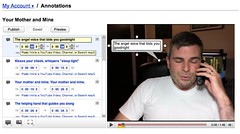
    YouTube Annotations
    Originally uploaded by Daniel Greene

    When I signed on to YouTube this morning, I noticed a new feature called Annotations that allows you to add Speech Bubbles, Notes, and Spotlights to your videos. I realized right away that the first two of these types of annotations gave me a way to caption my videos. They don’t allow for “closed” captioning; everyone who views the video sees them by default. There is a mechanism people can use, though, to turn them off while viewing them by clicking on the Menu button at the bottom of the player.

    This morning, I captioned a video that I recorded on Mother’s Day. At the time of this writing, it seems that you can only see the captions if you view the video on YouTube. YouTube says that, once they get this feature out of beta, they will support embeds, meaning that the annotations will show up when videos are shared in blogs, on Facebook, and the like.

    Although it was time-consuming (it took me about 45 minutes to an hour to caption a one-minute-forty-five-second [1:45] video), the graphical user interface (GUI) was rather intuitive. From my first experience using YouTube’s Annotations, I am certainly willing to use them again. Hooray for an easier way to caption videos!

  • Where was ASL, Deaf Presence in Super Bowl XLII?

    I was hoping that my colleague A Dreamer (yes, that’s his name) would be televised as he interpreted the National Anthem into ASL at the beginning of the big game. Unfortunately, this year’s coverage of the signing of the Star Spangled Banner was even less satisfying than last year’s. Last year, we at least got to watch Marlee Matlin signing “bombs bursting in air” on the big screen. This year, I was only able to see — by watching very carefully — the interpreter signing “flag was still there” (all in one nicely inflected ASL sign, by the way) on the Jumbo Tron behind Jordin Sparks’ head.

    And what about that Deaf Pepsi ad that was supposed to air? I never saw it. Did you?

  • iTunes Movies and TV Shows — Captioned?

    While Apple has announced a new Apple TV and movie rentals on iTunes, now more than ever it’s high time they made sure that all their video content is closed captioned. With the writers’ strike affecting television programming and more people switching to downloadable content, let’s not take a huge step backward by delivering a huge mess of inaccessible content over the Internet! The ADA does not require Internet deliverables to be closed-captioned because the ADA was drafted before the Internet, but the spirit of the law is to ensure that people have access to media, and since most movies and television shows have already been captioned for legacy media, it shouldn’t be difficult to deliver those captions along with new media. Apple has put the technology in place for the viewing of closed captions in iTunes, QuickTime, and iPods. The next step is actually selling and renting closed-captioned videos!