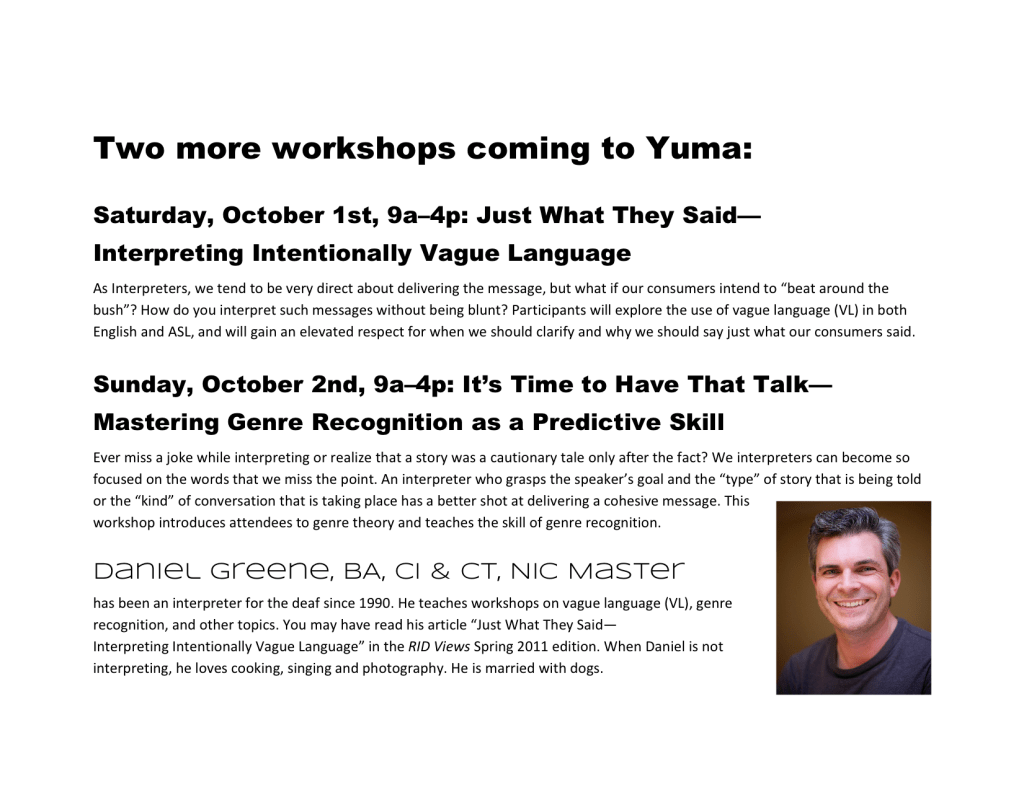
Here are the fliers & registration form for the Vague Language & Genre Recognition workshops I’m presenting in Yuma the first weekend of October (Oct 1st & 2nd). Both workshops will be held at the Southwest Regional Co-op, 1047 S 4th Ave Yuma AZ 85364, from 8a–3p with a one–hour lunch break. I hope to see people from both California and Arizona since Yuma is on the state line. Please pass the word so these workshops are a successful venture for the sponsor, Arizona RID, and reach the greatest number of people possible. See you there!
Tag: ASL
American Sign Language
-
Vague Language workshop at Western Oregon University August 12
I will be presenting my Vague Language (VL) workshop at a silent weekend at Western Oregon University on Friday, August 12, from 2:30 to 5:30 pm. This event is sponsored by the Western Region Interpreter Education Center (WRIEC) and happens to follow the first two–week colloquium of the first cohort of the Masters in Interpreting Studies / Teaching (MAIS) at Western Oregon University. I am excited about beginning my master’s degree and teaching about vague language (VL) at this silent weekend. Please register by completing the form below and check out the tentative agenda and topic abstracts. Hope to see you there!
Early Bird registration fees available only until July 1st. Registration, tentative agenda & workshop abstracts also at http://www.wou.edu/education/sped/wriec/silent_weekend.php
From the Silent Weekend coordinator:
Greetings!
On behalf of the ASL/English Interpreting Program at Western Oregon University, the Western Region Interpreter Education Center, the Oregon Department of Education’s Educational Interpreter Subcommittee, the Regional Resource Center on Deafness, and the Oregon Registry of Interpreters for the Deaf, we would like to invite you to join us for our third annual Silent Weekend, August 12-14, 2011 in Monmouth, Oregon. This weekend, conducted completely in American Sign Language (ASL), is for Deaf and hearing students, interpreters, mentors, interpreter educators, and ASL instructors.
Attendees and presenters can choose from two possible tracks – although they may participate in both – with corresponding workshops. The first is interpreter professional development, which is for working and pre-professional interpreters. The second track is for students and community members to develop their ASL skills and further learn linguistic features of the language.
Interpreters: This is an opportunity to earn up to 1.4 CEUs! If you are looking for some worthwhile workshops and a chance to sharpen your skills, then Silent Weekend is for you!
Thank you!
~CM
For more information, contact:
CM Hall, Ed.M., NIC Advanced, EIPA Ed K:12
Project Coordinator
Western Region Interpreter Education Center
Western Oregon UniversityW: 503-838-8731
C: 503-888-7172
Skype: WesternRegionInterpreterEdCenter
Facebook: Western Region Interpreter Education Center
Website: http://www.wou.edu/wriec
To learn more about interpreting as a career, visit
http://www.discoverinterpreting.comWRIEC is a collaborative endeavor of Western Oregon University and El Camino College and a member of the National Consortium of Interpreter Education Centers (NCIEC).
UPDATE: Attendance was so good they had to move the workshop into a bigger room. Thanks, everyone!
-

Can’t get enough workshops, Yuma? I’m coming in October!
My esteemed colleague Kirsten Nelson is presenting workshops in Yuma, Arizona this weekend, and I will be presenting workshops there first weekend of October. I’m sure Kirsten’s workshops are knocking their socks off, and I hope mine will blow their minds. By the time we’re done with them they’ll be barefoot and openminded! 😉
Here’s a little flier I made when Kirsten offered to plug my workshops at the end of hers:
-
Response to Eh? What? Huh? – Please Don’t Use Sarcasm With My Students
via Eh? What? Huh?: Please Don’t Use Sarcasm With My Students.
The original poster started a very interesting discussion about using language that might be misunderstood by children, and I am reposting my comment because I would like to share my viewpoint with my readers.
I wrote:
I can appreciate your concern for your students, (e, but I agree with MM. Although some ways of communicating may be confusing, I believe they should be taught rather than avoided. Each instance of misunderstood sarcasm can be a teaching moment for a second language learner. Sarcasm and other elements of second language, which English is for most deaf and hard-of-hearing people, have to be explicitly taught.
I sometimes have to reverse myself when I begin to — forgive the expression — “dumb down” my writing with deaf people. With certain people, things must be greatly simplified, but with many people I think one should be oneself and let the person figure it out. Most deaf people certainly don’t dumb down their ASL for me or slow down their signing for me. I am an interpreter, and they just expect me to understand them and interpret what they are saying. I learn new bits of visual language all the time because of deaf people’s being themselves and signing naturally. Don’t I owe them the same genuineness of myself? Perhaps the more I write English or — with the appropriate person — sign English or fingerspell unusual turns of phrase, the more I express who I am and give them the opportunity to learn how a hearing person speaks and writes.
It’s not that my place is to teach; it’s just that everyone–hearing and deaf alike–can learn more about each other and each other’s language when we speak naturally. I thank every French-speaking, Spanish-speaking, and ASL-speaking person who has ever spoken to me in their natural way, because that is how I have learned their languages.
 Daniel Greene