Tag: sign language

  • How to role shift using your body, not your feet

    How to role shift using your body, not your feet

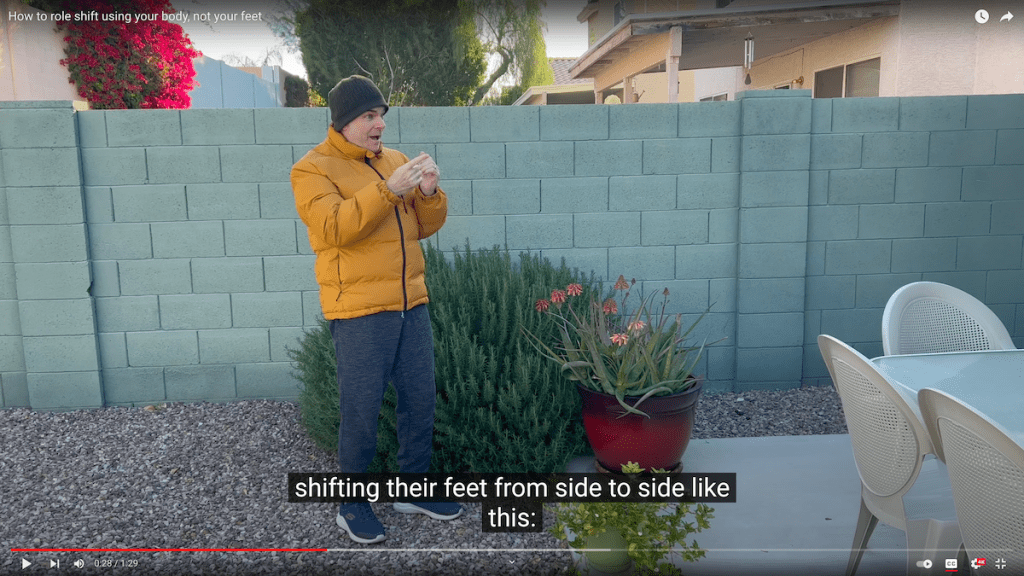
    This video is geared toward ASL students (or students of any signed language, I imagine) who might be making the mistake of thinking they have to move their feet when role shifting, a way to reenact dialogue between two characters in storytelling. I demonstrate how you can role shift by twisting your whole body, using your legs and bending your knees slightly while keeping your feet planted on the ground.

    Disclaimer and acknowledgment

    I am a non-native hearing signer, and I would not have made this video if I could find a video of a native Deaf ASL signer demonstrating how to role shift without stepping from side to side. One can assume from watching videos of Deaf signers role shifting that they are not moving their feet (e.g. ASL THAT), and curricula such as Dawn Sign Press’ Signing Naturally tell students not to move their feet, but students cannot see feet of the Deaf language models. I encourage everyone to watch Deaf people role shifting and see how smoothly they do it– especially if you get the chance to see them from head to toe!
  • Video I made of ASL sign vocabulary re: coronavirus (COVID-19)

    I made this video for my ASL students, as we are only together online now, and I decided to share it publicly in case others may benefit from it.

    Because I began learning ASL at age 21 rather than at birth, I like to point my students to Deaf language models. Here are two videos of Deaf people signing about COVID-19:

    There are many more videos out there! Please learn what you can to prevent the spread and talk about it in whichever language you choose.

  • I love you emoji 🤟 now in iOS 11.3! 😻

    I love you emoji 🤟 now in iOS 11.3! 😻

  • Mi desarollo como intérprete trilingüe

    Yo sigo en aprender español para que yo lo añada a mis lenguas de interpretación. Afortunadamente, aún a este punto intermedio de mi desarollo, a veces yo puedo hacer un poco de interpretación trilingüe. Por ejemplo, quizás yo interpreto para una cita médica en esta manera: hay un médico oyente que habla español e ingles, un miembro de familia oyente que habla español y el lenguaje de señas, y un paciente sordo que usa el lenguaje de señas americano. Cuando el médico y el miembro de familia hablan con juntos, yo interpreto al paciente sordo lo que están diciendo; cuando el paciente seña, el miembro de familia comprende el paciente y yo interpreto al médico en inglés. Si a cualquier tiempo no entiendo el español del médico o del miembro de familia, este doctor es dispuesto a decírmelo en inglés. !Se sale bien!


    I continue to learn Spanish so that I can add it to my interpreting languages. Fortunately, even at this point in my development, sometimes I can do a bit of trilingual interpretation. For example, perhaps I interpret for a medical appointment in this way: there is a hearing doctor who speaks Spanish and English, a hearing family member who speaks Spanish and sign language, and the Deaf patient who uses American Sign Language. When the doctor and the family member speak with each other, I interpret to the Deaf patient what they are saying; when the patient signs, the family member understands the patient and I interpret for the physician in English. If at any time do not understand the doctor’s or family member’s Spanish, this doctor is willing to say it to me in English. It works out well!

  • Paul & Tina’s Signalong: Haters gonna hate

    Paul & Tina’s Signalong: Haters gonna hate

    I am not as offended or concerned about Paul & Tina’s Signalong as some people are. I think exposure to ASL can be a good thing, regardless of who’s signing. Personal experience: the first time I was truly impressed with the beauty of ASL was at a monologue competition in 1985, when a hearing girl spoke and signed a monologue from Children of a Lesser God. I have no idea, in retrospect, how good she was at signing; all I remember is I thought it was beautiful. The fact that she spoke and signed at the same time made it accessible to me. I don’t think I would have gotten the same impression at the time if I had seen a Deaf woman delivering the same monologue, even if it were interpreted. I might have been more intimidated than entertained. I might have seen more differences than similarities. I might not have been ready for the culture shock.

    If you read the comments on Paul & Tina’s Signalong Facebook page post about taking down their donation site, you’ll see a variety of views, both supportive and critical, both from hearing and Deaf people. I think this dialogue is a good thing. The comments from d/Deaf people were more supportive than those from interpreters, though, and I think that’s telling. If Deaf signers want to be offended by Paul & Tina, and educate them about their language and culture, that is their job. It’s not ASL/English interpreters’ job to be offended for Deaf people.

    It’s not how you start, it’s how you finish

    Where you start isn’t necessarily where you end up. It’s not Paul & Tina’s job to be Deaf, and they’re not trying to be. They’re just being themselves and having fun with it. They’re not the be all, end all; they’re just doing their thing. Where people take it from there is their business. Time will tell whether future interpreters might have first thought ASL was fun by watching their videos. Eventually, we learn from Deaf people if we get that far. And if we don’t get that far, what’s the harm?