My Galaxy Tab 10.1 got Android 4.04 last night as I read they might. It’s customized, but nice.
Blog
-
Student teaching and thesis writing my last quarter in grad school
I just started co-teaching an Introduction to Interpreting class at Phoenix College yesterday. It’s a hybrid course, so I’ll be doing both onsite teaching and online teaching. Luckily, I’ve had experience with both kinds of teaching, especially since doing my teaching practica in three different courses last spring at Western Oregon University (WOU), where I taught in the course management system (Moodle) and via videoconference (Skype and Google Hangout).
The next five weeks are a break before my last quarter of grad school, and I’m taking this time to write the first draft of my master’s thesis on vague language (VL). Sometimes I think I need to keep writing this blog so it doesn’t fade into obscurity, and other times I think I’d better let it wait and settle for the delayed gratification of publishing my thesis. I suppose balancing both wouldn’t hurt; in fact, blogging regularly might help writing my thesis regularly and vice versa.
In the course I’m co-teaching, we’re using the books Sign Language Interpreting: Exploring Its Art and Science (Stewart, Schein, & Cartwright, 1998) and So You Want to Be an Interpreter (Humphrey & Alcorn, 2007). In writing my thesis, I’m using the book Writing Your Journal Article in Twelve Weeks: A Guide to Academic Publishing Success (Belcher, 2009) as a guide.
-
Ever forget an assignment? Make it less likely with automatic agenda emails.
 I hate to admit it, but there have been those mortifying times when I’ve forgotten I had a job to get to. It’s easy to follow a schedule when it’s the same every day, but when you’re a community interpreter and your schedule changes every day, you might need a little help.
Lately, some of the agencies I work for have started sending out automatic agenda reminders via email, such as “Here is your schedule for this week” or “Here is your schedule today.” These reminder emails are very helpful — so helpful I was about to ask an agency who doesn’t send them to send them. I rethought that, though, because I had forgotten a job with them that week and I didn’t want it to come across as, “Well, it would help if you sent me a reminder.” So I did some searching and found that I could set up my own email reminders in my Google calendar. Here’s how:
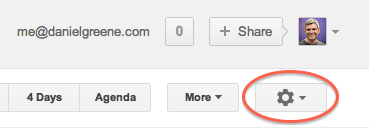
In your Google calendar, go to Settings. Currently the way to do this is to click on the gear icon in the top right corner of the page. When in Settings, click the Calendars tab from the tabs toward the top left of the page (where you see General, Calendars, Mobile Setup, Labs). For your work calendar, look for the Notifications heading just right of the center of the Calendar line (where you see CALENDAR, SHOW IN LIST, NOTIFICATIONS, SHARING). Follow the Notifications link for your work calendar. Scroll to the bottom of the page where it says, “Daily agenda: Receive an email with your agenda every day at 5am in your current time zone.” Check the box next to Email and/or SMS, and you’re done! You will now get your very own agenda reminders at the crack of dawn.
Go forth and serve thy Deaf and hearing consumers!
P.S. I know not everyone uses Gmail or Google Apps, but maybe the calendaring program you use does this too. If not, maybe you should get with a program that does.
-
Is talking with a group better than talking to the world?

twitter logo map 09 (Photo credit: The Next Web) Last week, I had a realization that maybe talking to a group — or with a group — was more satisfying than talking to the world. This week, the makers of Twitter started two new ways of communicating this week: Branch and Medium. How funny to see my thoughts being reflected in new media! Perhaps the thought that it’s more satisfying to speak with a group than to speak to the world is an idea whose time has come, but I think it depends on what you’re talking about. I’m sure that Biz Stone and Evan Williams don’t mean to disparage Twitter, the medium they started — though they certainly seem to in their introductory video to Medium. In the video, the voiceover narrator says, “There’s noise, outspoken jerks, off-topic bickering, empty engagement. We know we can do better.” Maybe they think they have to say what we’ve been doing is not working, so we have to do their new thing. Sort of like creating the problem to sell the solution. I think it’s more like an “and” than an “or,” though, even in the way they frame it. They may disparage Twitter too much albeit not by name, but they also sell Branch and Medium as ways to, well, branch off Twitter into longer and more intimate conversations — that they world can see. If our greatest writers only ever shared with small groups, we wouldn’t have great books. Then again, some of our greatest books started out small, and some of our greatest writers were unappreciated in their lifetimes. It’s all a matter of balance. I’ll try all three. My Twitter handle is @danielgreene, and it will be the same on Branch and Medium. Maybe I’ll talk with you there!
What do you think are the advantages & disadvantages of sharing with groups and sharing with the world?
Related articles
- Twitter founders launch two new websites, Medium and Branch (guardian.co.uk)
- Medium is well done, but is it the future of publishing? (gigaom.com)
- The Cofounders Of Twitter Launch A New Blog Platform, Medium (businessinsider.com)
- Twitter Co-Founders Aim for Third Hit (inc.com)
- For Twitter founders, Medium is the message (sfgate.com)
- Twitter Founders Start Two New Sharing Sites – Medium & Branch (devicemag.com)
- Twitter Founders Want to Reinvent Digital Publishing – Again (mashable.com)
- Twitter Founders Launch Medium, a New Collaborative Publishing Platform (allthingsd.com)
 Daniel Greene