Category: Language

My observations about grammar, language, and linguistics

  • How to role shift using your body, not your feet

    How to role shift using your body, not your feet

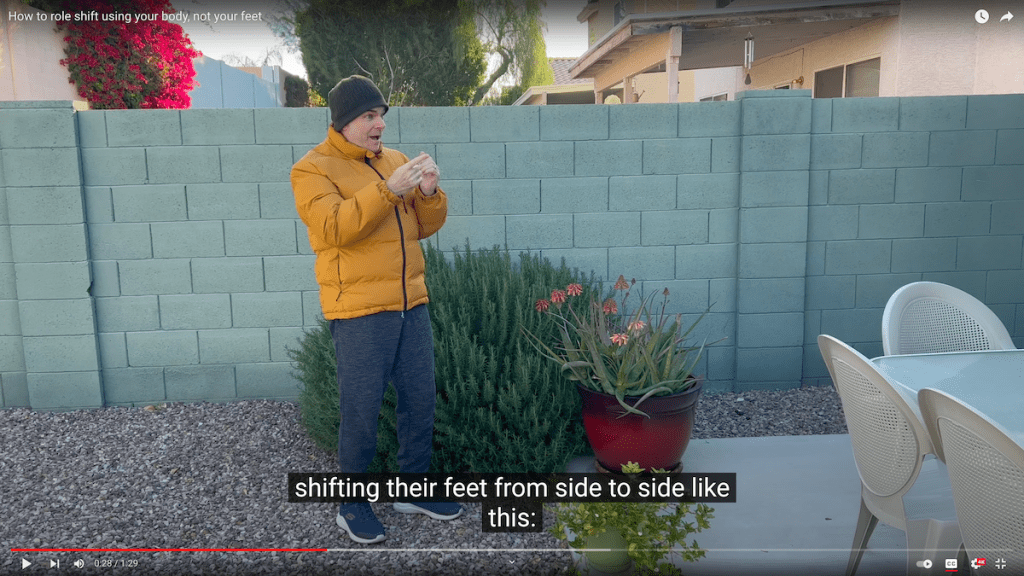
    This video is geared toward ASL students (or students of any signed language, I imagine) who might be making the mistake of thinking they have to move their feet when role shifting, a way to reenact dialogue between two characters in storytelling. I demonstrate how you can role shift by twisting your whole body, using your legs and bending your knees slightly while keeping your feet planted on the ground.

    Disclaimer and acknowledgment

    I am a non-native hearing signer, and I would not have made this video if I could find a video of a native Deaf ASL signer demonstrating how to role shift without stepping from side to side. One can assume from watching videos of Deaf signers role shifting that they are not moving their feet (e.g. ASL THAT), and curricula such as Dawn Sign Press’ Signing Naturally tell students not to move their feet, but students cannot see feet of the Deaf language models. I encourage everyone to watch Deaf people role shifting and see how smoothly they do it– especially if you get the chance to see them from head to toe!

  • I read a Walt Whitman poem in English, Spanish, & French

    I read a Walt Whitman poem in English, Spanish, & French

    Someone introduced me to Reverb, so:

    • I read a short poem by Walt Whitman in English, Spanish, and French.
    • Leí un poema de Walt Whitman en inglés, español, y francés.
    • J’ai lu un poème de Walt Whitman en anglais, espagnol, et français.

    https://record.reverb.chat/embed/XuwKTXw9cDhCXUPGBNXo

    Sources / Fuentes / Sources

  • Some girls are tomboys. This boy was a marygirl.

    Some girls are tomboys. This boy was a marygirl.

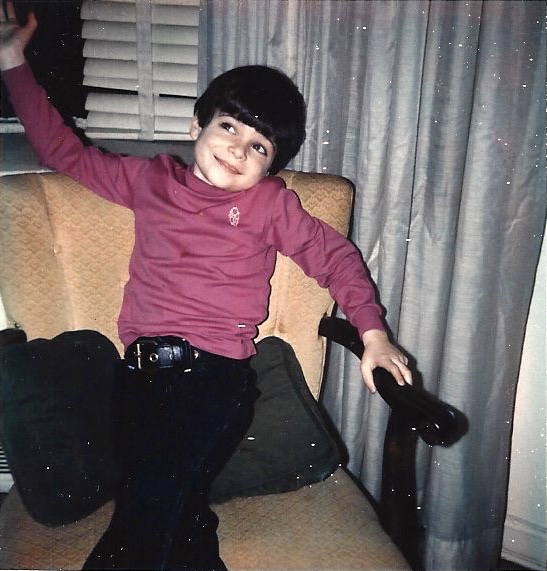
    I coined a phrase for my own gender identity when I was five years old. I used to like dolls, tea sets, and playing pat-a-cake with girls instead of playing with boys. I liked talking about my thoughts and feelings more than most boys. I was slightly effeminate — sometimes more than others. A girl I was playing and talking with one day in a far corner of the playground at school asked me why I was that way. This is what I said:

    “You know how some girls are tomboys? Well I guess you could call me a marygirl.”

    Like many tomboys I outgrew that and became more typical of my physical gender; i.e., more masculine, but I’m proud of my ability at that age to give voice to how I felt, and even to normalize it. Other boys called me a sissy when I skipped down the halls singing, but I rejected that label and the pain that came with it, and declared my identity with a label of my own.

    Were you / are you a marygirl? Is your son / nephew / grandson a marygirl? I’d love to hear about it in the comments.

  • Touching Amazon commercial in ASL

    Just saw — not heard, but saw — this TV commercial featuring a Deaf Amazon logistics associate. There’s no interpretation or voiceover, just his signing and captions. There is some background warehouse noise, but the relative silence focuses attention on this man who communicates without sound. I was really touched to see American Sign Language used by a Deaf person in a commercial featured during primetime national television. As an ASL/English interpreter, I have interpreted for Amazon many times, so it was even more exciting and surreal to see this representation of people I’ve had the honor to work for.

  • Remembering a black substitute teacher who taught us about Black English Vernacular

    Remembering a black substitute teacher who taught us about Black English Vernacular

    I don’t remember the scholar’s name, but she was a black woman who substitute taught at our school (the Mabel E. O’Farrell School of Creative and Performing Arts in Southeast San Diego, which was a black neighborhood) one day in AP English in 1985. Although her last name escapes me, I remember when she introduced herself she said she was “Doctor [so-and-so]” because she had earned her doctorate studying what she called Black English Vernacular (BEV). Funny the things I remember from 35 years ago!

    I recall how she explained that there was no voiced th (eth) sound in the African languages the slaves spoke, so that is why they said “dem” and “dey” and why black people still do to this day— or at least still did in 1985, when she gave us her marvelous lecture. She also explained that if a girl says “When my daddy come home, he be tired,” the girl is using the verb to be in its habitual aspect, which slaves learned from their white enslavers in the 15- and 1600s. She also explained how “I done been sick” means “I have been sick in the past but I am no longer” and “I been sick” means “I have been sick lately and I still am.” What she told us is that BEV is not English without rules; in fact, its grammar — influenced by that of the English, Dutch, and Scottish white settlers and slaveholders — has even more rules, including some tenses it might be nice if present-day English had. Funny thing is, all these decades later, the “[pronoun] be like [refer to picture]” meme is all over the Internet to be appreciated by — and proliferated by — not just black people but everyone.

    I may have forgotten Doctor lady’s name, but I have never forgotten her pride in her studies and her culture, and her generosity and motivation in sharing them with us so that we could appreciate more about our own language and that of the people we live with. This is my last-minute, leap day Black History Month recognition of a scholar who taught me a lesson I have never forgotten.

    Featured image by www.scootergenius.com