Archives: Projects

  • Lesson plan incorporating teaching methods & moves

    Lesson plan incorporating teaching methods & moves

    This project was completed for EDU250, Teaching in the Community Colleges. The assignment for this project was:

    This week you reviewed chapters 11-17 [in Nilson, 2010], exploring ways to choose and use the right tools for teaching and learning.

    You read that it begins with the learning outcomes/objectives. So for this project, you will select 1-3 learning objectives for the class that you identified in the syllabus project that you would cover in an hour long class period.

    Using the techniques and information that you learned in the readings, identify the teaching and learning techniques that you would use to engage your students in the content during that hour long period.

    Submit a plan for that hour including:

    • The learning objectives to be covered
    • Agenda for the hour
    • The format for the class
    • Teaching methods to be used
    • Teaching moves to be used
    • A description of why you chose the format, each method and each move and how they relate to your learning outcomes/objectives.

    Course Competencies

    1. Apply the ability to initiate, conduct, and terminate a short specific conversation in ASL. (XIII)
    2. Apply receptive and expressive mastery of grammatical features of ASL— pronouns, verbs, tense indicators, negatives, adjectives, adverbs, classifiers in specific commands, questions, and statements. (II-IX)

    Learning Objectives

    1. Engage in a first-meeting conversation
    2. Ask and respond affirmatively or negatively to yes/no questions
    3. Know what questions Deaf people are likely to ask you when you first meet them, and know how to respond appropriately

    Class Format

    • seminar as students learn the language as written in the textbook and modeled on the DVD before class, and prepare in pairs to role-play the conversations in front of the class. Why I chose this: so that students learn through group work and modeling/teaching.
    • lecture/discussion: instructor will lecture students to explain what needs to be clarified, depending on students’ misunderstanding; students will discuss the nature of introductory conversations. Why I chose this: so that students engage in critical thinking and instructor guides the students toward competence.
    • skill activity: students practice the conversations with each other. Why I chose this: so that students develop competence in using the language and engaging in common discourse routines.
    • All three class formats relate to all course competencies and learning objectives.

    Agenda

    Noon–12:10: Students 1 & 2 will demonstrate Conversation 1 from Homework 2:1. Students 1 & 2 will teach the grammatical features, sign production, and sign order to the class.

    12:10–12:15: Instructor will lead class discussion of whether students executed conversations correctly. Instructor will guide Q & A between the classmates and Students 1 & 2.

    12:15–12:20: All students will practice Conversation 1 with each other, with Students 1 & 2 split up and working paired with other students in the class. Instructor will supervise and correct students as necessary, also being available for Q & A.

    12:20–12:25: Instructor will give general notes and corrections of manual and nonmanual production errors, will guide discussion and general Q & A.

    12:25–12:35: Students 3 & 4 will demonstrate Conversation 2 from Homework 2:2. Students 3 & 4 will teach the grammatical features, sign production, and sign order to the class.

    12:35–12:40: Instructor will lead class discussion of whether students executed conversations correctly. Instructor will guide Q & A between the classmates and Students 1 & 2.

    12:40–12:45: All students will practice Conversation 1 with each other, with Students 1 & 2 split up and working paired with other students in the class. Instructor will supervise and correct students as necessary, also being available for Q & A.

    12:45–12:50: Instructor will give general notes and corrections of manual and nonmanual production errors, will guide discussion and general Q & A.

    12:50–1:00: Instructor will lead students in a discussion of “Insight: Making Connections” about what Deaf people commonly ask when they first meet hearing ASL students.

    Teaching Methods

    • role plays as students play the roles of people first meeting each other and exchanging introductory information
    • recitation as students recite the phrases they have learned
    • directed discussion as instructor leads students in discussing the execution of the role plays and the typical questions people ask each other when they first meet
    • classroom assessment techniques as instructor walks around the classroom while students are practicing the conversations they are learning and makes corrections as needed
    • student-peer feedback as students will critique role players on their execution of the conversations to be recited
    • just-in-time teaching as instructor notes and corrects the common errors seen among the students during classroom assessment

    Teaching Moves

     Knowledge

    Instructor will “suggest prior knowledge to which students can link new and future information and knowledge” and students will “recognize and identify information” (Nilson, 2010, p. 111). Why I chose this: During the last discussion, instructor will ask students to tell what questions they would ask of a student learning English as a second language, and will guide students to seeing how these questions are the same as or different from the questions Deaf people ask of students learning ASL as a second language.

    Evaluation

    Instructor will “explain with examples how factors such as culture, experience, desires, interests, and passions, as well as systematic thinking, influence choice and interpretations” and students will “detect mistakes, false analogies, relevant versus irrelevant issues, contradictions, and faulty predictions” (p. 111). Why I chose this: During final discussion, instructor will ask students how they thought the questions Deaf people would ask them are the same as or different from the questions the students would ask students of English as a second language. Instructor would explain why or why not the two lines of questioning were the same, informing the students of the values of Deaf culture so they know what to expect from their interactions with Deaf people.

    References

    Godot13 (2013). “Czech 2013 Prague Astronomical Clock Face.” Wikimedia Commons. Retrieved from http://commons.wikimedia.org/wiki/File:Czech-2013-Prague-Astronomical_clock_face.jpg

    Maricopa Community College District Official Course Competencies for SLG101. Retrieved from Center for Curriculum & Transfer Articulation, http://www.maricopa.edu/academic/ccta/

    Nilson, Linda B. (2010). Teaching at its best: A research-based resource for college instructors. Wiley. Kindle Edition.


  • 5 things I’ve learned about course objectives

    5 things I’ve learned about course objectives

    1. Design the course with the end in sight.

    no end in sight... - It's PIER day!
    no end in sight… – It’s PIER day! by Mecki Mac, on Flickr

    2. Display the college’s course objectives the first day.

    A Rough Introduction to Circuit Bending (Garnet Hertz, 2010) - General Directions and Objectives
    A Rough Introduction to Circuit Bending (Garnet Hertz, 2010) – General Directions and Objectives by G A R N E T, on Flickr

    3. Discover the students’ course objectives the first day.

    "Before I Die I Want To..." KS Rives/Nicole Kenney
    “Before I Die I Want To…” KS Rives/Nicole Kenney by Chicago Art Department, on Flickr

    4. Don’t waste time on busywork unrelated to course objectives.

    BusyWork( o
    BusyWork( o by chrstphre ㋛ campbell, on Flickr

    5. Assess students’ achievement of course objectives.

    From "Here’s a Way to Make Your E-Learning Course Objectives Interesting" by Tom Kuhlmann
    From “Here’s a Way to Make Your E-Learning Course Objectives Interesting” by Tom Kuhlmann


    This project was completed for EDU250, Teaching in the Community Colleges. The assignment for this project was:

    Using the sites that were provided in the eTech challenge, conduct a creative commons search for 5 images that are demonstrative of what you have learned so far in this class. Then use one of the tools that you have been exposed to so far in this class to display the images and any supporting information you would like to supply. If needed provide an overview of what you are conveying through your images in the your discussion board post and provide a link to your project.

  • Plans to instill critical thinking throughout an interpreting course

    Plans to instill critical thinking throughout an interpreting course

    I co-created this with two other teachers as a group project in the Teaching Critical Thinking teacher symposium at VRSII.

    Proposed Syllabus for Instilling Critical Thinking throughout a Course: Consecutive ASL-to-English Interpreting (adapted from UBD Lesson Planning Template)

    By Daniel Greene, Doug Stringham, and Christia Williams, colleagues in VRSII Symposium for Teaching Critical Thinking

    Desired Outcomes/Goals (After the course/lesson the student will be able to…)

    Recognize, analyze, apply, and evaluate the use of critical thinking skills in consecutive interpreting from English to American Sign Language (ASL).

    Essential Questions (Assumption Hunting)

    • What is the relationship between ASL skills and Interpreting skills?
      (A possible assumption may be that students assume ASL skills = interpreting skills; One must have native-like fluency in order to effectively interpret into ASL.)
    • How do my assumptions about the topic (pace, speaker, etc.) during brainstorming and prediction affect my performance during the work?
      (Possible assumptions may be that students fear certain topics or faster rates of speech, etc. and that will reduce the level of critical thinking during interpreting work.)
    • What does “evidence of processing” look like?
      (A possible assumption may be that students are unaware of observable behaviors present during processing; students may be unaware of the correlation between effective processing and interpreting product.)

    Evidence (How will I know the student has achieved these outcomes?)

    Performance Assessments
    • Consecutive interpreting product
    • Self-analysis of product with critical thinking reflection
    Other Evidence
    • Journal Responses
    • Critical Incident Questionnaires (CIQs)
    • Informal Instructor Observations

    Activities (How do I support the acquisition of the knowledge and skills above?)

    According to Brookfield (2012), activities should be sequenced developmentally and represent the following categories: Social/Small Groups (S), Modeling (M), Concrete (C), Disorienting Dilemmas (DD)

    Worked Problem Exercise (Beginning, M/C/S)
    Related to cognitive load theory, worked problems have been shown to increase cognition and understanding of a given task. Instead of giving a novel or decontextualized setting or problem, allow students to view a prerecorded interpretation (e.g., what is the problem, show the process and solution) as well as interact with the problem. Before starting, lead a TAP (talk about/think aloud protocol) or ‘pre-brief’ (predictive assumptions review), produce an interpretation, and then debrief after the event. What assumptions did/do they have about the problem? Elicit observations or assumptions on their self-monitoring behaviors. Based on those assumptions, did they have the same ideas about the process and/or solution?
    Rapid Text Exercise (Advanced, C/DD)
    Using/Engineering a text that is rapid in pace but light in content (e.g. extra fillers, nonsemantic information, etc.), have students interpret the text. Film their interpretive work and then allow them to watch the work to how they react to the stress of the text. Allows students to self-monitor their reactions to the event.
    Cold Text Exercise (Advanced, C)
    Similar to the Rapid Text Exercise, have students cold-interpret a text. Film their interpretation and then allow them to watch their work to observe how they reacted to the stress of the text. Allows students to self-monitor their reactions to the event.
    Back-translation Exercise (Beginning, Intermediate, Advanced; S/C)
    Can be adapted to meet the developmental needs of students at any level. Model with an anonymous interpreting sample (Beginner); invite a student to produce an interpretation (I1) and then allow another student to watch the interpretation in order to produce a derivative interpretation (I2) without sharing the results (Intermediate) or with peer debriefing (Advanced); finally, students back-translate their own interpretations. How equivalent are the two interpretations? Are there observable self-monitoring behaviors present?
    Original Text Analysis Exercise (Beginning if working with someone else’s original text, Intermediate to Advanced if working with peer/self-generated texts; S/C)
    Have students either produce an interpretation of or listen/take notes to an original text. Debrief on a comparison of their interpretation/notes and what the text actually contains. Were there discrepancies? How did students listen/not listen to the text? An adjunct critical thinking event might be to have a discussion about WPM: “how does a high WPM impact your assumptions? A low WPM? Is it possible that WPM is deceiving? WPM vs. units of meaning per minute?”
    Discourse Mapping Exercise (Beginning, Intermediate, Advanced, depending on stimulus; S/C)
    Lead students in a discourse mapping (Merithew, 2002) event. Before starting, lead a TAP (talk about/think aloud protocol) or ‘pre-brief’ (predictive assumptions review), watch the interpretation, create discourse maps (both in groups and/or individually), and then debrief after the event. What assumptions do they have about the interpretation? Based on those assumptions, what ideas presented/appeared (which do you prefer? I don’t know if resulted makes sense) in their maps? Did they observe any self-monitoring behaviors?

    Additional Resources and References

    Brookfield, S. D. (2012). Teaching for critical thinking. San Francisco, CA: Jossey-Bass.

    Wiggins, G. & McTighe, J. (2005). Understanding by design. Alexandria, VA: Association for Supervision and Curriculum Development.

    Witter-Merithew, A. (2002). Understanding the meaning of texts and reinforcing foundation skills through discourse analysis. In Tapestry of Our Worlds: Proceedings of the 17th National Conference of the Registry of Interpreters for the Deaf, Inc. Alexandria, VA: RID Publications.

  • Master’s Thesis

    Master’s Thesis

    Greene, D. (2013). Keeping it vague: A study of vague language in an American Sign Language corpus and implications for interpreting between American Sign Language and English. (Master’s thesis). Available at http://digitalcommons.wou.edu/theses/2

  • Reflection & artifacts that demonstrate student outcomes

    Reflection & artifacts that demonstrate student outcomes

    This was part of my capstone portfolio project in graduate school.

    Description of Assignment

    Reflection and artifacts that demonstrate student outcomes (or some other standards or proficiencies identified by the student and approved by faculty supervisor) were achieved:

    1. Effective interpreters able to work with a wide range of deaf, hard of hearing, and hearing clients communicating in a variety of settings and circumstances.
    2. Discerning consumers of current, credible research findings on translation, interpersonal communication, meaning transfer, professional aspects of interpreting and professional development.
    3. Critical observers of the factors that impact professional interpreter  decision-making from accepting a job to billing for the job.
    4. Committed leaders and capable researchers in the interpreting profession able to advance the profession beyond its current status and understanding within the communities they serve.
    5. Effective facilitators of adult learning environments designed to guide students in their development as interpreters, professionals, and life long learners.
    6. Discerning consumers of current, credible researching findings on adult education, curriculum design, assessment construction, lesson planning, and effective practices in the field of interpreter education.
    7. Leaders in interpreter education pre-service and in-service, providing innovative training that raises the bar of expectations and quality within the field of interpreting.

    Outcome #1: Effective interpreters able to work with a wide range of deaf, hard of hearing, and hearing clients communicating in a variety of settings and circumstances

    My first public interpreting job: Deaf Day at Sea World, July 1990

    In my interpreting career since 1990, I have interpreted in almost every setting except the courtroom. I have even interpreted a few legal situations with experienced legal interpreting teams to guide me. I interpreted in VRS and VRI for seven years until 18 months ago when I began this master’s program. While studying interpreting and teaching interpreting with Western Oregon University, I have continued to interpret in a variety of settings including academic, conference, medical, social services, and vocational. For reasons of confidentiality, it is not possible to post evidence of this work, but I have continued to blog about my work on my blog, Daniel Greene’s TerpTransTwitter, and Google+.

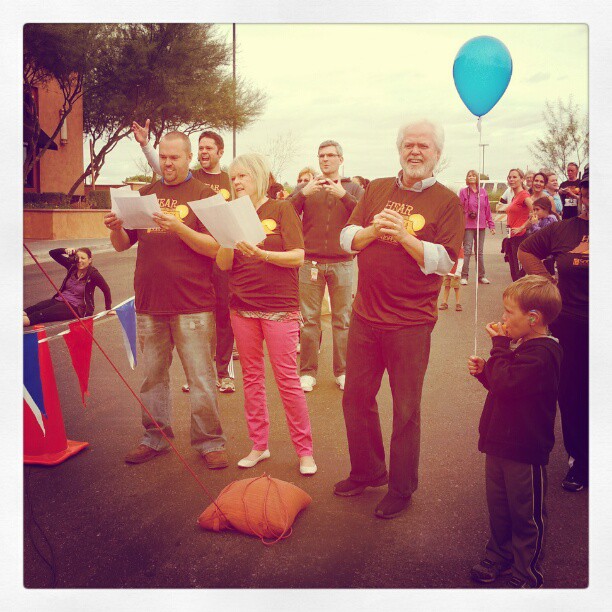
    My latest public interpreting job: Hearing in the Mesa 5K run for Justin Osmond, Shane Osmond, Mary & Merrill Osmond on November 17, 2012.

    Outcome #2: Discerning consumers of current, credible research findings on translation, interpersonal communication, meaning transfer, professional aspects of interpreting and professional development

    My work in this program has shown my consumption and comprehension of research on these topics. My work is also shown in the literature review in my thesis on vague language.

    Also shown by the following required and recommended readings I assigned to students in Introduction to Interpreting, some of which included my considered responses to other authors:

    I even wrote some blog entries during the course that synthesized current research and changes in the profession:

    Outcome #3: Critical observers of the factors that impact professional interpreter decision-making from accepting a job to billing for the job

    During my teaching practicum course, I taught a unit in an ethics and professionalism course in Western Oregon University’s BA in interpreting program. I designed the unit to teach ethical decision-making in stating qualifications, accepting a job, and getting to the job. I gave students an example by sharing with them a link to my interpreting résumé and asking them to post basic credentials or a résumé. I also posted discussion boards on Moodle with job offers that were modeled after actual emails I had received from interpreting agencies with details changed to preserve confidentiality. I had the students in the class respond with questions about information they needed to know to accept the job. Once a student accepted a job, I posted responses based on job information emails I have gotten from interpreting agencies I work with. Finally, I created an ethical scenario video with colleagues Stacey Rainey and Erin Trine.

    Outcome #4: Committed leaders and capable researchers in the interpreting profession able to advance the profession beyond its current status and understanding within the communities they serve

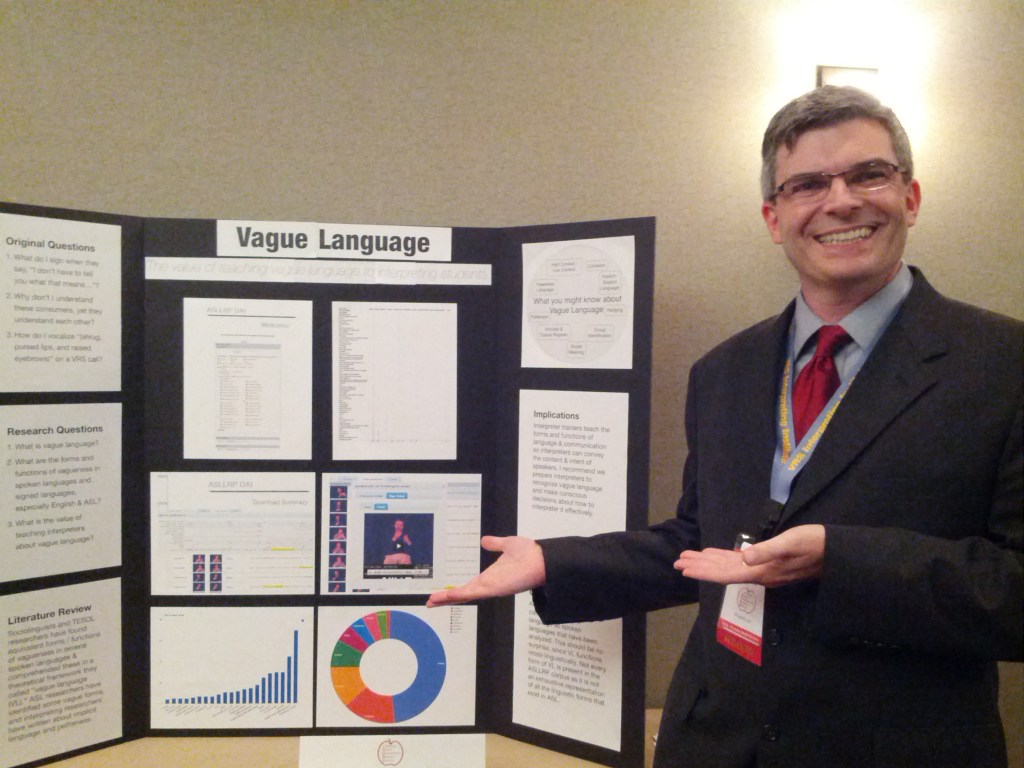
    As shown by this poster session I presented at the Conference of Interpreter Trainers in October 2012:

    Me and my VL poster at CIT 2012
    Me and my VL poster at CIT 2012 – Vague Language: The value of teaching vague language to interpreting students

    Poster Pages

    Mind map: What you might know about Vague Language

    ASLLRP DAI screenshot
    ASLLRP Database Access Interface (DAI) screenshot that shows how I searched for various signs, gestures, participants, and stories

    Screenshot of a full gloss of a sentence in the ASLLRP DAI

    Screenshot of ASLLRP Sign Video example

    Top 21 Vague Terms bar chart

    Top 9 Vague Categories pie chart

    Outcome #5: Effective facilitators of adult learning environments designed to guide students in their development as interpreters, professionals, and life long learners

    As shown by this voiced-over video presentation I made for the students in my Introduction to Interpreting class at Phoenix College:

    Outcome #6: Discerning consumers of current, credible researching findings on adult education, curriculum design, assessment construction, lesson planning, and effective practices in the field of interpreter education

    As shown by my Lesson Plan on Certification and Professional Organizations:

    Outcome #7: Leaders in interpreter education pre-service and in-service, providing innovative training that raises the bar of expectations and quality within the field of interpreting

    As shown by my work in my student teaching position in the Introduction to Interpreting class at Phoenix College and these two workshops I taught as an invited lecturer in Minneapolis in November 2012:

    I also pioneered using Google+ Hangouts to teach a workshop.

  • RID Views Feature

    RID Views Feature

    Greene, D. (April 2011). Just what they said: interpreting intentionally vague language. Feature Story in Views(28)1. Alexandria, VA: Registry of Interpreters for the Deaf.

  • At Issue: Sexting

    At Issue: Sexting

    Greene, D. (2011). The threat of sexting has been exaggerated. In S. Kiesbye (Ed.) At Issue: Sexting pp. 15-18. Farmington Hills, MI: Greenhaven Press.

  • My photos on Cabela’s T-shirts

    My photos on Cabela’s T-shirts

    You can read the whole story about how photos I took at Cabela’s were commissioned for T-shirts on the blog post I wrote at the time.

    This slideshow requires JavaScript.

  • Eyes of Desire 2

    Eyes of Desire 2

    Greene, D. (2007). My first deaf guy. In R. Luczak (Ed.) Eyes of Desire 2: A Deaf GLBT Reader pp. 243-245. Minneapolis, MN: Handtype Press.