For this semester’s exit exams during finals week, I updated the rubric I posted on iRubric last semester. I did this for two reasons:
Someone commented on the original blog post that I forgot fluency. After noting that general fluency was one of the criteria on the Signing Naturally “Storytelling Evaluation Sheets,” and after reviewing more rubrics, I decided to add it.
I wanted a rubric that would be easier to score on a five-point scale for grades A, B, C, D, and F. The old rubric had four levels of proficiency; this one has five.
Yes, I’m familiar with this. The segregation of black Deaf children in black Deaf schools, and the segregation of black and white people in general, led to a distinct variety of ASL. The cultural and linguistic heritage of that dialect endures today.
When I was a video relay service (VRS) interpreter, I saw Deaf people call in from all over the US, and I learned a lot of different signs I had never seen before, since there are so many regional varieties. I saw difference in pace, rhythm, signing space, syntax, words that were fingerspelled instead of signed, and vice versa.
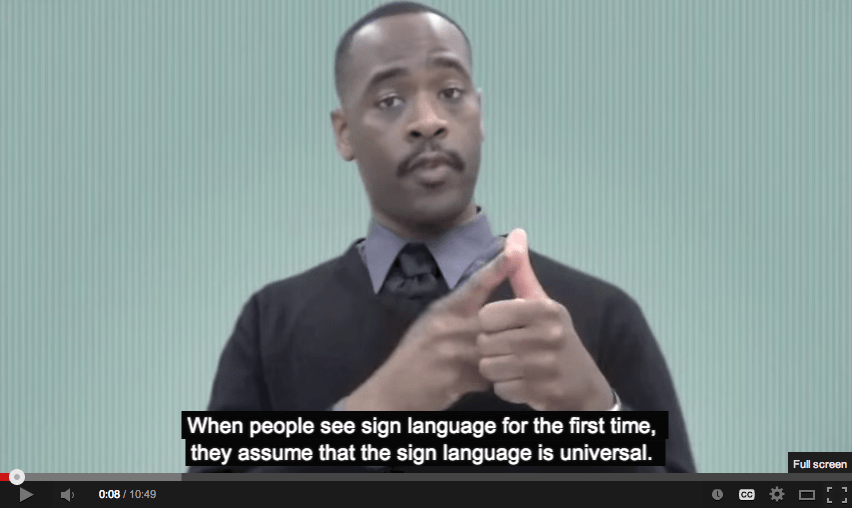
I wish this would not come as a surprise to hearing people who know nothing of ASL, because they should understand that ASL is as varied as spoken language, and emerges and evolves organically among language communities. Instead, it seems most hearing people assume that ASL is a fixed system invented by hearing people and taught to Deaf people all over the world. They also seem to assume that Deaf people take what is “given” to them without question or alteration. Of course they don’t realize they assume this, but the way they talk about it, they do. For example, when I tell them I am an ASL interpreter, they assume I teach ASL to Deaf people, as if Deaf people needed a hearing person to teach them how to communicate. They also say things like “why isn’t it universal? It should be!” I ask them “why isn’t English universal?” They seem to take for granted that hearing people have the sovereignty to create and use their own languages, yet they think Deaf people don’t create their own ways of communicating, and should be made to communicate the same way all over the world.
I’ll leave you with the video that inspired the original article:
I find it interesting to follow the interpreting field in general, not just the ASL-English interpreting field, and the other day I saw a surprising post on a blog I follow called The Professional Interpreter: Many medical interpreters are missing out on a prestigious and profitable field. The author, Tony Rosado, a Spanish-English interpreter, says that most medical interpreters do not venture from interpreting medical jobs to interpret medical conferences. I don’t think of conference interpreting as more prestigious and profitable than interpreting in medical settings, but things may be very different between signed-spoken and spoken-spoken language interpreters.
Qualified interpreter means an interpreter who … is able to interpret effectively, accurately, and impartially, both receptively and expressively, using any necessary specialized vocabulary.
According to the article, until recently there were no standards for medical interpreting. It is important to note, though, that the author is not talking about interpreting between deaf and non-deaf people; he is talking about interpreting for people who do not share the same spoken language. Interpreters for deaf people are provided as an accommodation mandated by the Americans with Disabilities Act and previous laws such as PL 94-142 and Section 504 of the Rehabilitation Act. Such mandates create a demand for quality; in fact, Title III of the ADA sets the legal definition:
Qualified interpreter means an interpreter who, via a video remote interpreting (VRI) service or an on-site appearance, is able to interpret effectively, accurately, and impartially, both receptively and expressively, using any necessary specialized vocabulary. Qualified interpreters include, for example, sign language interpreters, oral transliterators, and cued-language transliterators.
I am interested in hearing from interpreters of all language pairs to see what you think about conference interpreting as opposed to medical interpreting. In your experience, have you found conference interpreting to be more profitable than medical interpreting? Do you find that your colleagues and/or consumers respect you more for doing conference interpreting than medical interpreting? Personally, I find both equally rewarding, both personally and financially. It can be stimulating and glamorous to interpret for someone charismatic while facing a large audience, yet it is challenging and rewarding to interpret for a doctor and patient in a private room. I like both settings, and feel respected in both settings. What do you like?
I asked one of my ASL classes to take 3 minutes the other day and write whatever came to mind about how they would like to learn ASL– what kinds of classroom exercises, texts (books, videos), homework, tests, whatever. I did this because it seemed like some things weren’t working for some of the students in the class, and I wondered if they had any better ideas about how to learn. I think it was interesting for them to write, and I certainly got some ideas from them I will put into action; in fact, I already made some changes this morning. In addition to making changes in the course, I feel it improved the trust we have in each other, since they know that I want to listen, and I know that they want to learn– maybe just in different ways.
Afterword: The exercise I assigned the students was in line with my training in education and my educational philosophy. I am using Signing Naturally Units 1-6, and I have no intention of tossing it out. I also use the Teacher’s Curriculum Guide and the included materials, such as slideshows. I think the workbook and DVD are great, but I want to get my students’ perspective on their course materials. I know I am the ultimate decision maker when it comes to what I want to teach, but they are the ultimate decision makers when it comes to what they want to learn. Ultimately, no teacher can force a student to read a book or watch a DVD. The students are the ones who must choose to use the tools they have or augment their learning with other resources. My thought is that, in the process of imagining their dream class, the students are forced to imagine the kinds of “work” they would do if they had the freedom to choose. I asked them, “tell me how you would learn ASL if it were up to you– and not just magically, but by working at it. If you don’t like what you’re reading, watching, or doing, what else would you propose?” I stressed realism while at the same time inviting imagination.
To give you an example of a change suggested in the free-writes, three (out of 9) students suggested putting off Unit 6 to the end of the semester rather than threading it through the other units as the Signing Naturally Semester Syllabus suggests. I decided to try their suggestion, this semester at least. It’s a relatively minor change, they appreciate me for it, and I feel like no less of a leader for doing it.
There is a sign in ASL some call CHA-HEAD because “cha” is the mouth morpheme used in ASL for something big, and the sign for BIG is made around the head level to indicate a “big head” (figuratively speaking). The formal gloss for this sign is ARROGANT (glosses are conventionally written in ALL CAPS). Since ASL has no written form, when people want to write about ASL, or talk about it in English, they assign glosses to signs. The benefit of these glosses is they give us a way to transcribe ASL for the purposes of notation and translation. The drawback of these glosses is they tend to limit our translation of these signs that one gloss, rather than to what the signs actually mean in context.
as any good interpreter or translator knows, words and signs in one languages do not always have single word/sign equivalents in another
One example of a gloss that I believe limits our vocabulary is the gloss ARROGANT for the sign, well, let’s call it CHA-HEAD for lack of a better word other. The thing we might forget is that CHA-HEAD often doesn’t mean anything as extreme as arrogant. A few cases in point: I was interpreting a video relay call some years ago (and of the thousands of call I interpreted in seven years, this is one that stands out), and a Deaf brother signed to his hearing brother something to the effect of YOU CHA-HEAD TELL DAD. I (unfortunately) voiced, “it was arrogant of you to tell him.” The hearing brother said, “I’m not arrogant!” I realized at that moment is was my interpretation, not what his brother said, that he was responding to. I asked the Deaf caller to hold just a moment, and I explained to the hearing caller, “this is the interpreter— sorry about that interpretation. A better interpretation would have been, “you shouldn’ta done that.” I chose that interpretation on second thought because that’s what the Deaf person’s utterance “felt” like when I saw it; in other words, that was the sense of what the Deaf person signed. I had made the mistake of interpreting the form of the word I had been taught for that sign, and the translation was woefully off. When I really thought about it for a moment (and how many “moments” do we really have when we are interpreting a phone call?), I realized not only did the sign not mean arrogant; it really didn’t even translate to a particular word, but more to an expression.
Another case in point, which brought this up for me recently: I was debriefing with a fellow interpreter, and I felt I needed to call them out on something they did on the job that I felt was less than appropriate (as I’ve said, I believe interpreting teams need to be blunt with each other for the sake of consumers. We were conversing in both our languages (as bilingual people often do), and I said, “I thought that was a little [switching to ASL without mouthing] CHA-HEAD.” My colleague said, “it wasn’t arrogant!” Now, you have to understand, this colleague is an intelligent, well-educated, and seasoned interpreter, so if they thought of the word arrogant when confronted with that sign, it tells me the connotation is well entrenched among ASL-English interpreters. What I said to them was, “well, I didn’t mean arrogant; I just meant kind of liberal [in the demand-control schema sense of favoring action as opposed to inaction].” I just felt that they had done something that overstepped an interpreter’s bounds a bit. Of course, that is arguable, and the point is not which one of us was “right” or “wrong”— the point is that my colleague took exception to my ASL sign because of the denotation assigned to it by the English gloss.
A Thesaurus of Translations for CHA-HEAD other than ARROGANT
Since the sign in question means so many things milder than arrogant, here is a list of translations with a range of meanings to match a range of situations. Note these are not all single words, because as any good interpreter or translator knows, words and signs in one languages do not always have single word/sign equivalents in another. These translations are context-dependent, and are not by any means suggested to be one-size-fits-all. Pick and choose what suits the situation. Here’s my list as of now:
presumptuous
to take it upon oneself to…
to go right ahead and…
to just…
familiar
forward
to overstep
overstepping one’s bounds
beyond one’s place
crossing the line
a bit much, don’t you think?
the nerve!
to have the nerve to…
ballsy
cheeky
brazen
bold
conceited
big-headed
full of oneself
taking liberties
inappropriate
to think [one] can just…
I’m sure the list could go on, but that’s all I can think of at the moment. Do you have any other translations? Please leave a comment. Thanks!


 Daniel Greene