Tag: workshops

  • First workshop on Google+ Hangout a success

    Online participant’s view of Fostering Independence workshop conducted in a Google+ Hangout

    Learning from colleagues via Daniel Greene’s workshop… all from the comfort of my home while my daughter naps. Amazing technology!

    –online participant

    Introduction

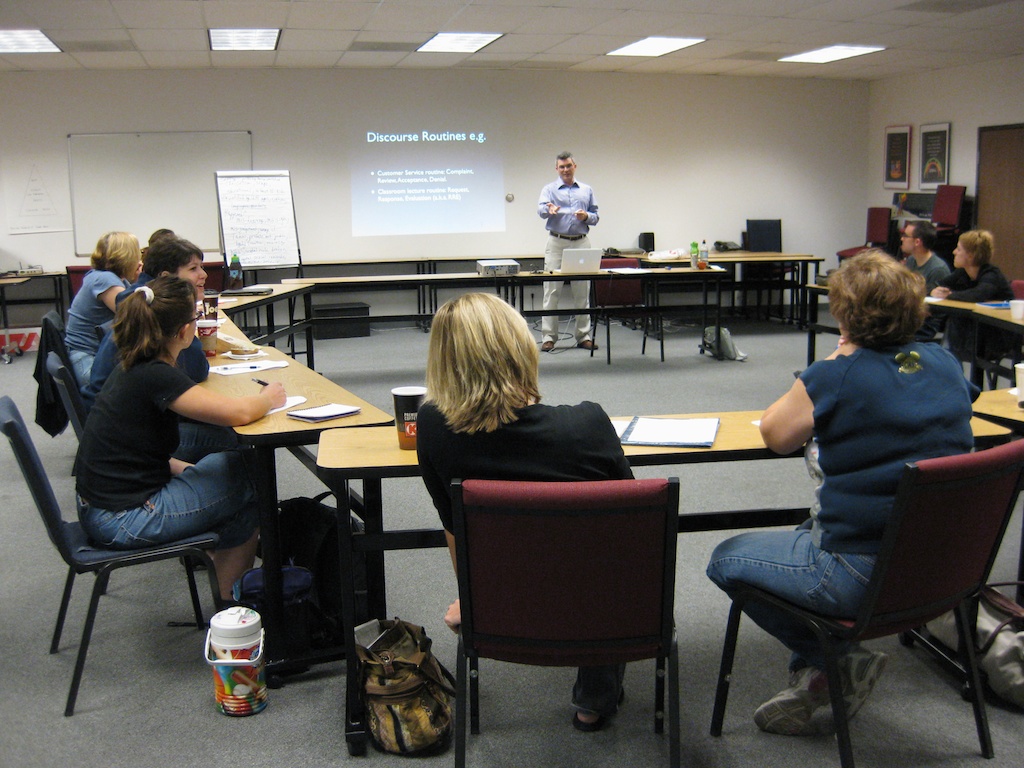
    Yesterday, I included online participants in one of my workshops for the first time. I had used the technology in my teaching practicum last quarter in grad school, but this was the first time I used a Google+ Hangout to give a three-hour workshop as a solo presenter. We had a small turnout for this one, including two participants online and three participants on site. The two online participants connected separately, I had my own connection, and the three onsite participants had two laptops between them, so we had a total of five video connections. A Hangout will hold ten video connections, so we could have had five more Google+ Hangout participants — six more if we had only used one connection for all the onsite participants. And of course we could have had more onsite participants.

    Methods

    I advertised the Google+ Hangout on Google+, Facebook, Twitter, and my blog two days before the event. I had online participants register with the site coordinator and pay me directly via PayPal. I had the participants check to see that they had Google+ accounts and send me their Gmail addresses so I could find them on Google+ and add them to a Circle. The site coordinator emailed my handouts and slides to the online participants as PDFs so they could follow along on their screen or print them as they saw fit. She also got the participants’ details so she could process CEUs. The onsite participants had my handouts printed, and I also showed my slideshow on the screen behind me.  I conducted the workshop in English, and in addition to using the Hangout for talking, I used the Hangout YouTube app to show a video to the participants. I could have used the Slideshare app to share my slides as well, but I wanted to keep it simple and not “tempt fate” by overloading the system. I told my students I would start a new Hangout and invite them if we all got disconnected; that avoids the problem of people inviting each other and refusing each other’s invitations because each one wants the other to join the Hangout they started.

    Results

    I was able to harness the technology to extend my teaching, and the students/participants gave me excellent scores and comments on the evaluations. I had hoped for some interpreters of languages other than ASL and English, but as it turned out, we were all ASL/English interpreters. We did experience some packet loss or “freezing video” a couple of times, and the online participants had to reconnect once or twice, but thankfully we never lost the Hangout altogether. We onsite people tended to look at the laptops in front of us more than each other, so it was a bit like we were all online participants. I shared my observation and suggested with some levity those of us in the room “might look at each other once in a while.” We did balance looking at the screens with looking at each other so that all participants felt included.

    Discussion

    All-in-all, it was a great experience for all of us. The online/onsite hybrid was a fascinating dynamic with us onsite looking at laptops in front of us, yet I was glad  I had participants in front of me onsite as well as online. I’m glad I didn’t cancel the workshop due to low registration, and even though extending the workshop online only brought two extra participants, the small number was cozy and the interaction was rich. It was worth it for what we were all able to learn from each other about getting out of the way and fostering independence.

  • Webshop Wednesday – Fostering independence: How interpreters can get out of the way when consumers don’t need us

    google_plus_logo_original
    Google+ logo

    This Wednesday, July 4th, from 1–4 PM Arizona Time (same as PDT), I am excited to open my workshop to participants on a Google+ Hangout. Interpreters on Google+ have asked me when I would be offering a workshop online, and now I finally am. This workshop costs $30 USD and offers .3 continuing education units (CEUs) through the Registry of Interpreters for the Deaf Certificate Maintenance Program (RID CMP). CEUs are sponsored by the Arizona Commission for the Deaf and Hard-of-Hearing (ACDHH). We will webcast from the Desert Valley’s Regional Co-op in Phoenix, Arizona. The language for this workshop will be English. The onsite participants will be ASL/English interpreters yet the workshop is designed for interpreters of all languages. Also, although we will only be processing CEUs for RID members, anyone is welcome to join, and perhaps you can apply to your own programs for CEUs.

    Official PayPal SealHangouts can hold up to 10 participants. I and a few onsite participants will take two screens, so there is room for up to 8 online participants. To register, please download the registration form and follow the directions. Note that Fostering Independence is the only online workshop at this time, and be sure to include the email address you use for your Google+ account. When Amerigo receives your registration, she will acknowledge your enrollment and you may send $30 USD plus PayPal fees ($31.17, if my calculations are correct) to my verified PayPal account. I will then add you to a private circle and  invite you to join our Google+ Hangout at 1 PM Arizona Time on Wednesday.
    Workshop Description

    This workshop is held on Independence Day for a reason. The NAD-RID Code of Professional Conduct (CPC), Tenet 4, Respect for Consumers, admonishes interpreters to “Facilitate communication access and equality, and support the full interaction and independence of consumers.” Supporting consumer interaction and independence demands that we get out of the way when consumers don’t need us to interpret for them. Various models of interpretation have viewed the interpreter-client relationship in different ways, but do not focus much on the client-client relationship. This workshop will review some well known and lesser-known models of the interpreter-client relationship, examine the “Rescue Triangle,” and introduce a model of interpretation that focuses on the client-client relationship. Participants will have ample time to reflect upon their own professional practice and see how they may be sometimes standing in the way of their clients’ relationships with each other; participants will be guided to identify ways in which they can get out of the way of client-client relationships and foster independence.

    (Don’t worry — there won’t be that many onsite participants this time!)

    Presenter Bio

    Daniel Greene, BA, NIC Master, has been studying and practicing the teaching of ethics and professional practice in the Masters of Arts in Interpreting Studies/Teaching program at Western Oregon University for the past year. Since 1990, he has interpreted the gamut of settings including business, conference, education (pre-school to post-doc), medical, performing arts and video. His love of arts and literature informs his work, and his passion for elevating the interpreting profession drives him to study lesser-known aspects of interpretation and teach interpreters new skills.

  • Presenting Deaf-Blind interpreting workshop today, Oral Transliteration tomorrow

    The conference organizers, participants and I are creating an ohana of learning to strengthen the lives of interpreters and our clients!

    Posted from WordPress for Android

  • Workshops on deaf-blind interpreting, oral transliteration at RID V in Hawaii

    Workshops on deaf-blind interpreting, oral transliteration at RID V in Hawaii

    I am presenting two workshops at the RID Region V conference in Hawaii June 13–17:

    Lend me an ear. And a hand. And a black shirt: What you need to know about deaf-blind interpreting.

    Have you ever had consumers who asked you to “sign small” and “wear a black shirt”? If you have done video interpreting, chances are you have interpreted for deaf-blind “low vision” consumers at least a few times. Less likely is that you have interpreted for low vision consumers in person, and even less likely is that you have ever done tactile interpreting— which technology has not yet made possible over VRS. This workshop will introduce you to various kinds of blindness and teach you how to accommodate your signing space to the resulting kinds of “low vision.” You will also learn the basic techniques of tactile interpreting and informing the consumer about the environment. Come expand your repertoire. No black shirts required.

    Read my lips: Making English visible through oral transliteration

    This workshop provides an overview of oral transliteration: what it is, who uses it, and how to do it right. Come and learn: Why some deaf people want to read your lips; How you can be pro-Deaf culture and still respect and serve oral deaf people; How you can transfer what you’ve learned in ASL interpreting to oral transliteration. Have you ever been sent to a job where the person didn’t know sign language but wanted to read your lips, and you didn’t know what to do? Here’s a good place to start. Unlearn some of the “good habits” in sign interpretation that are “bad habits” in oral transliteration. Increase the number of consumers you can serve. People of all knowledge levels are welcome.