Category: Education

  • Rave Review for my Vague Language Workshop

    I was honored that a participant in my Vague Language (VL) workshop for ASL interpreters was moved to write this review for our local chapter of the Registry of Interpreters for the Deaf (Arizona RID). The writer wishes to remain anonymous, but I found out who they are and got their permission to publish their review on my website. I assure you that this review was entirely unsolicited and is reprinted here in the writer’s original words. Here it is!

    Hi everyone. I was able to attend the workshop this past Saturday by Daniel Greene entitled, “Just What They Said: Retaining Ambiguity When Interpreting Vague Language.” This was an excellent workshop for a number of reasons and I’m thrilled that Daniel has taken it up to present this topic because it is one thing I know I have struggled with and it hasn’t been addressed enough in regards to the work we do as interpreters. There was so much that I learned.

    It was all about vague language of course which has really been brought to light, I think, by video relay interpreting but certainly applies to the work we do in education. It is a fairly new topic in linguistic studies too. It is the concept that people do use vague and unspecific language in their everyday interactions and often it is for a purpose that they are being vague. This brings up the question, do we as interpreters then clean it up and make it clear, do we interrupt the conversation to get clarification, or do we just render the message as vague as it was given? Keep in mind it might be the person’s goal to be vague.

    For example: a teenager might wish to cover up the truth to avoid getting in trouble; a teacher might wish to protect a student’s feeling when giving feedback about work; a person might just be trying to be polite in their use of words; a doctor might wish to be less direct about a person’s life expectancy; a counselor might purposely need to ask an open ended question without leading the client with examples. How much of this can and should an interpreter try to clarify?
    (more…)

  • Speak & Spell II a Successful Workshop

    My first Speak & Spell workshop went so well that people demanded more, so I put together a Speak & Spell II workshop. I improved upon the first workshop by organizing all the phonological and orthographical features by feature rather than by language. I also tweaked a few other things based on participant feedback.

    Eleven people attended the second of my phonology / orthography workshops, Speak & Spell II. It went very well. I got the workshop evaluation feedback today, and the average of all scores was 5.0, the highest rating possible.

    My next workshop, "Just What They Said: Retaining Ambiguity when Interpreting Vague Language" is next Saturday, September 26th, from 1-6:30 PM in the same location, the Desert Valleys Regional Cooperative. Thanks to Joy Marks who continues to support my workshops and allows me to use this excellent facility. This coming workshop is sponsored by the Arizona Registry of Interpreters for the Deaf. Anyone interested may register and pay for the workshop on Arizona RID’s Professional Development page.

  • My First Speak & Spell Workshop


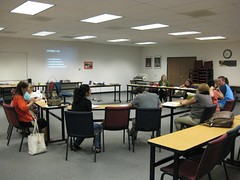
    My Speak & Spell Workshop

    Originally uploaded by Daniel Greene

    Thanks to Joy Marks at the Desert Valleys Regional Cooperative for taking this photo and for providing the logistical support and classroom, and thanks to Joy and ACDHH for providing the promotional materials and CEU sponsorship. Thanks also to the 15 people who attended. We all had a good time and I do believed we all learned a lot- including me as I did my research in developing the workshop!

    My workshop title was Speak & Spell: How to Pronounce & Spell Foreign Names & Words, and it involved a comparative survey of the phonologies (sound systems) and orthologies (spelling conventions) of a variety of the world’s languages. I mixed lecture with interactive exercises that encouraged participants to spell, pronounce, talk about and explore international names and words. Our focus in this workshop was the mastery of foreign spelling and pronunciation in our ASL-to-English and English-to-ASL interpreting.

    I’m happy to say my workshop was a success! I’m now going to spend the next two months developing my next workshop, “Just What They Said: Retaining Ambiguity When Interpreting Vague Language” on Saturday, September 19 from noon to 5:30 PM (location TBA).

  • Upcoming Workshop: Speak-N-Spell: How to Spell & Pronounce Foreign Names & Words

    I’m teaching my next workshop at the Desert Valleys Regional Cooperative on Wednesday, July 15, from 5:30-8:30 PM. I designed this workshop to help ASL interpreters to recognize foreign names and words when they hear them so that they know how to fingerspell them, and to recognize foreign names and words when they see them fingerspelled so they know how to pronounce them. The workshop examines the phonologies of various languages and gives participants tools for further study so they can increase their knowledge of foreign spelling systems. For more info, download this flier / application form.

  • After my first conference workshop

    I presented my workshop "Knowing What They’re Going to Say Before They Say It: Using Genre Recognition to Improve Your Predictive Skills" at the Arizona RID (Registry of Interpreters for the Deaf) State Conference on Saturday, March 28, 2009 from 1-4:30 PM. It was the first time I’d ever presented at a state conference, and they put me in the smallest meeting room (the Palo Verde room) at the Hilton Airport Hotel in Phoenix, Arizona.

    Can you believe that a total of 27 attendees filled this room beyond capacity? I was astounded at the turnout. I was too busy during my workshop to even think about taking pictures, but as I was leaving the space after packing up all my things, I paused to say a prayer of thanks; then I took this photo to commemorate the moment. I am hopeful to teach workshops at other conferences throughout the rest of my life. It may sound corny, (more…)