Tag: community

  • WordPress themes not showing author bylines explained

    The other day, I expressed my concern on the WordPress Support Forums that my author bylines were gone from my posts in this blog using the Twenty Twelve theme. Today I got a response from staff explaining that, because of feedback from the WordPress community, they started using CSS (the style markup that composes the themes) to hide the author byline on some, but not all, themes. This makes the byline invisible in the normal, theme/CSS-enabled view, but if you view the page without the theme/CSS you will see the bylines.
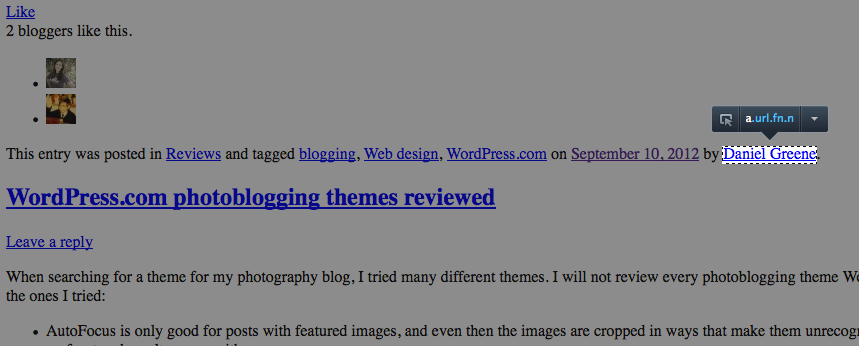
    Screenshot courtesy of Josh, a WordPress Happiness Engineer
    Screenshot courtesy of Josh, a WordPress Happiness Engineer

    This means the search engines can read the bylines and verify authorship. I checked this with Google’s Rich Snippet Testing Tool and found the search engine did, in fact, read my byline and verify my authorship. This is good to know!

    For anyone who knows HTML and CSS and is curious, here is the HTML:

    <span class="by-author"> by <a title="View all posts by Daniel Greene" href="https://danielgreene.com/author/danielgreene/" rel="author">Daniel Greene</a></span>

    And here is the CSS that does the trick:

    .by-author&nbsp;{display:&nbsp;none;}

    If you are interested in viewing the code on your own blog, there are various ways to view source code.

  • Me in my fingerspelled university t-shirt

    Me in T-shirt
    Me in my fingerspelled W-E-S-T-E-R-N Oregon University t-shirt
  • Ever forget an assignment? Make it less likely with automatic agenda emails.

    I hate to admit it, but there have been those mortifying times when I’ve forgotten I had a job to get to. It’s easy to follow a schedule when it’s the same every day, but when you’re a community interpreter and your schedule changes every day, you might need a little help.

    Lately, some of the agencies I work for have started sending out automatic agenda reminders via email, such as “Here is your schedule for this week” or “Here is your schedule today.” These reminder emails are very helpful — so helpful I was about to ask an agency who doesn’t send them to send them. I rethought that, though, because I had forgotten a job with them that week and I didn’t want it to come across as, “Well, it would help if you sent me a reminder.” So I did some searching and found that I could set up my own email reminders in my Google calendar. Here’s how:

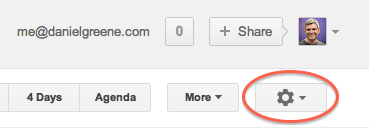
    In your Google calendar, go to Settings. Currently the way to do this is to click on the gear icon in the top right corner of the page. When in Settings, click the Calendars tab from the tabs toward the top left of the page (where you see General, Calendars, Mobile Setup, Labs). For your work calendar, look for the Notifications heading just right of the center of the Calendar line (where you see CALENDAR, SHOW IN LIST, NOTIFICATIONS, SHARING). Follow the Notifications link for your work calendar. Scroll to the bottom of the page where it says, “Daily agenda: Receive an email with your agenda every day at 5am in your current time zone.” Check the box next to Email and/or SMS, and you’re done! You will now get your very own agenda reminders at the crack of dawn.

    Go forth and serve thy Deaf and hearing consumers!

    P.S. I know not everyone uses Gmail or Google Apps, but maybe the calendaring program you use does this too. If not, maybe you should get with a program that does.

  • Who cares what I have to say?

    Me singing @ Piano Zinc, Paris 1997

    Today it’s Facebook, Google+, Twitter. Yesterday it was rap groups, support groups, open mic. I don’t remember feeling like nobody cared what I had to say when I was speaking to people in person. Now that I’m writing for the Internet — for the past 17 years or so, and sharing on social media for the past six — I’m wondering if anyone cares what I have to say. I don’t think I’m alone in this. So many people are sharing so much, be it on blogs or social media, that it’s impossible for us all to take each other in. I guess some people on the Internet form communities like groups on Flickr or writers of similar blogs on WordPress. But I like the idea of sharing with the world, or should I say, being heard by people all over the world. I’d like to think that people care what I have to say, but the stats on my posts often don’t show that they do. And maybe they don’t. We can’t all care what we all have to say, can we? Maybe it’s okay to say it, though. Maybe it’s okay to journal publicly, and if someone gets something out of it, great. If not, we’ve simply made public something we would have written in a journal anyway, and there’s no reason to keep it a secret. Some say we live in a time of oversharing, and that might be true. I would like to think, though, that even if no one cares what I have to say until years from now, or even if I’m the only one who cares what I have to say, it’s worth it. I might look back on this years from now and be glad I wrote it. Someone reading this today or many days from now might take solace in it. I guess for now I’ll try not to care whether anyone cares what I have to say, and just keep saying what I have to say.

    P.S. Come to think of it, when I was talking to people in person, I was talking to groups, not the world. Maybe there is something to sharing on the Internet with groups after all. What do you think? Please leave a comment below. I do care what you have to say.

  • Settings vs. specializations: Categorizing interpreting work

    Interpreter Patricia Stöcklin whispers interpreting to Garry Kasparov. Klaus Bednarz is speaking on the lit.Cologne 2007 Français : L'interpréteur Patricia Stöcklin traduit en chuchotant à Garry Kasparov. Klaus Bednarz parle au lit.Cologne 2007. (Photo credit: Wikipedia)
    Interpreter Patricia Stöcklin whispers interpreting to Garry Kasparov. Klaus Bednarz is speaking on the lit.Cologne 2007 Français : L’interpréteur Patricia Stöcklin traduit en chuchotant à Garry Kasparov. Klaus Bednarz parle au lit.Cologne 2007. (Photo credit: Wikipedia)

    Is “freelance” a setting? I’ve heard people say they used to be “educational” and now they’re “freelance.” What they mean is they used to be employed full-time at a school and now they work as an independent contractor for agencies. Yet interpreters can work full-time in schools and be “freelance” if they’re working at that school as independent contractors. By the same token, there are interpreters who work for agencies as full-time employees, and they do doctor’s appointments, business meetings — the same kinds of work as interpreters who call themselves “freelancers.” I think interpreters get their settings and specialties mixed up, and I think it can cause confusion to those entering the field, those who hire us, and even ourselves and each other. Knowing what’s what can give everyone a better understanding of what we do. Here is how I suggest we distinguish interpreting settings from interpreting specialties: (more…)